
Everyone says they follow the process. The forecast says otherwise.
Ask your AEs if they run the process. They will say yes. Ask them if they got a second stakeholder on the call. Yes. Set a next meeting before the demo ended. Of course. Then look at the pipeline: single-threaded deals, close dates that keep moving, a stage-three conversion rate that has drifted for three quarters. Either your process does not work or your AEs are not running it. You cannot tell which, because the only evidence is what the AEs typed into HubSpot after the call.
CRM notes are the AE's account of the call. They are honest, usually, and useless for this purpose, because they record what the AE thinks happened. An AE who believes they ran discovery will write "good discovery, strong pain" about a call where they shared their screen at minute nine. You are not managing the process. You are managing the AE's memory of it.
The two bad options founders bounce between
Option one: sit on calls. Join the Zoom, listen, take notes, coach afterward. It works, for the two calls a week you have time for. Eight AEs run forty demos a week. You are seeing five percent of the process and the AEs know which five percent, because you are on the invite. Option two: trust and check revenue. Leave the AEs alone, look at closed-won at quarter end, and find out in week twelve that half the team stopped running discovery in week two.
Most founders alternate between the two and resent both. The problem is not the AEs and it is not your patience. The work is invisible. Only 29% of companies can see whether training changed what their reps do. If you cannot see the calls, you cannot see the process, and every conversation about it is an argument between two opinions.
Step one: write the process down as checkable steps
Most SaaS sales processes exist as a methodology deck and a stage definition in the CRM. Neither is checkable on a call. Rewrite yours as five to eight things that must happen on a demo, phrased so a listener could mark each one yes or no. Did the AE confirm the cost of the problem in the prospect's numbers? Was a second stakeholder present or named? Was pricing presented with a rationale, not just a number? Did the call end with a dated next meeting and a named attendee?
This document does two things. It gives your AEs a standard they cannot argue with, because it is yours, not a vendor's. And it gives a scoring tool something to score against. In Revenue OS your uploaded process carries 60% of every real-call score, with the remaining weight on six general skills: value stacking, objection handling, close timing, price presentation, follow-up setup, and talk-to-listen ratio. Your steps outweigh the method because your steps are what close your buyers.
- Cost of the problem confirmed in the prospect's own numbers
- Second stakeholder present or named with a reason
- Price presented with a rationale tied to the problem
- Dated next meeting with a named attendee before the call ends
Step two: score every demo, not the ones you happen to join
Tag the Zoom meeting "Demo:" and it records, transcribes, scores itself against your process and the six skills, and syncs the score to HubSpot. Every demo, not a sample. The best and worst moment are timestamped, so when you do open a recording you jump to minute 31, hear the AE accept "let me take this back to the team" without a date, and close the recording ninety seconds later. Ten minutes a day covers the exceptions across the whole team.
Consent matters. Your company initiates the recording and owns consent, including in all-party consent states. Most SaaS teams already announce recording at the top of a demo and Zoom shows its own indicator. Audio is deleted 90 days after upload and no voiceprints are created. Put the policy in writing before the first tagged demo, and tell the AEs what is being scored and why. A standard everyone can see is coaching. A secret one is surveillance.
Step three: read one number per AE instead of forty recordings
The Compliance Score is one number per rep, 0 to 100, recalculated nightly, weighted 30% training completion, 25% daily tasks, 25% role play quality, 20% manager enforcement. It measures behavior the AE controls today, not revenue, because revenue lags. An AE who stopped running discovery in week two will still close old pipeline in week six, and the revenue number will hide it until it is expensive. The behavior score shows it tonight.
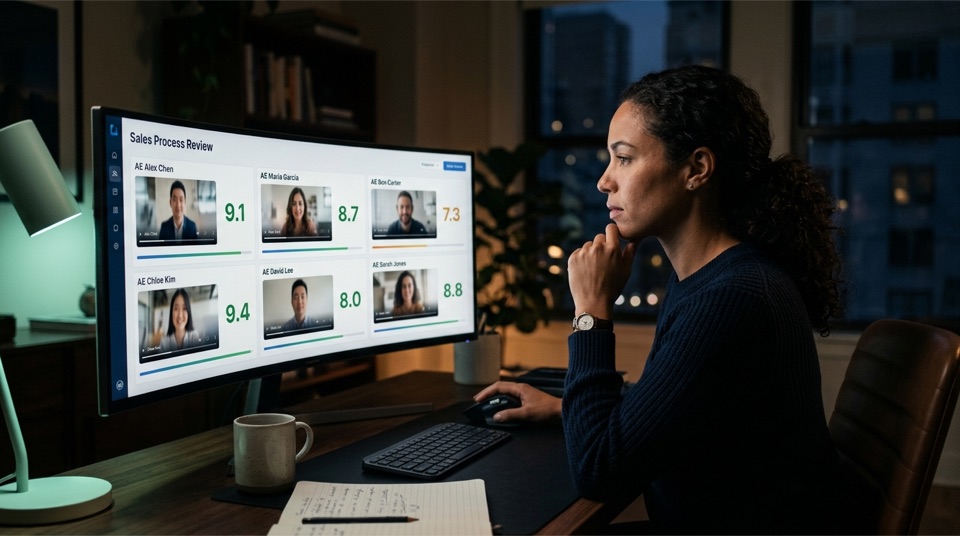
Every morning: one screen, eight AEs, eight numbers, sorted. Two are below the line. You know who you are talking to and what about, because the score shows which component slipped and the demo scores show which step of the process is being skipped. The AE at 91 gets left alone, which is what good AEs want. The AE at 58 gets a five-minute conversation about minute 31. That is not micromanaging. It is knowing.
What to do with what you see
A demo under 80 becomes a redo due 6pm the next business day against an AI buyer seeded with the real prospect's words, so the AE practices the step they skipped with the prospect who deserved it. Managers get a coaching queue sorted by urgency, so the thirty minutes a week most managers actually have go to the right AE and the right moment. Patterns across the team show up too: if six of eight AEs skip the second stakeholder, that is a process problem, not a people problem, and you fix it in the lesson rather than in eight conversations.
Within a month you will know something most founders never learn: whether the process works when it is actually run. If the AEs who run it close and the AEs who skip it do not, you have a process worth enforcing and a clear list of who to enforce it with. If everyone runs it and the conversion rate still drifts, the process needs work, and you found that out from evidence rather than a quarter of missed forecast. Either way, you are managing what happened on the call instead of what the AE remembered about it.
The short version
- CRM notes record the AE's memory of the call, not the call. You cannot manage a process from them.
- Sitting on calls covers five percent of demos. Checking revenue finds the problem a quarter late.
- Rewrite your process as checkable steps a listener could mark yes or no, and score every demo against it.
- Read one nightly behavior score per AE instead of forty recordings; open only the timestamped worst moments.
- When most of the team skips the same step, fix the lesson, not eight AEs.
Questions owners ask
Is scoring every AE demo micromanaging?⌄
No. Micromanaging is watching the work happen. Scoring is knowing whether it happened. The founder never joins the call, never reads every note, and never texts for updates. The score reports whether the process was run and points to one moment when it was not. Good AEs tend to prefer it, because it proves they do the work and keeps the founder off their calls.
What if AEs object to being recorded and scored?⌄
Tell them what is scored and why, and make the standard your written process rather than a black box. Reps argue with generic scores. They rarely argue with a score that says they skipped step four, the one the founder said never to skip. Make the scores visible to the team and tie low scores to a specific redo, not punishment. Pushback fades within a few weeks.
How does this work with HubSpot and Zoom?⌄
A Zoom meeting tagged "Demo:" records, transcribes, and scores itself against your process and six general skills, then syncs the score to HubSpot on the deal record. Recordings from other tools can be uploaded and scored the same way. Your company initiates recording and owns consent. Audio is deleted 90 days after upload, and no voiceprints or biometric identifiers are created.
See how the system runs in SaaS.
Revenue OS for SaaSYour best month ever, and the plan to beat it.
Break Your Revenue Record