
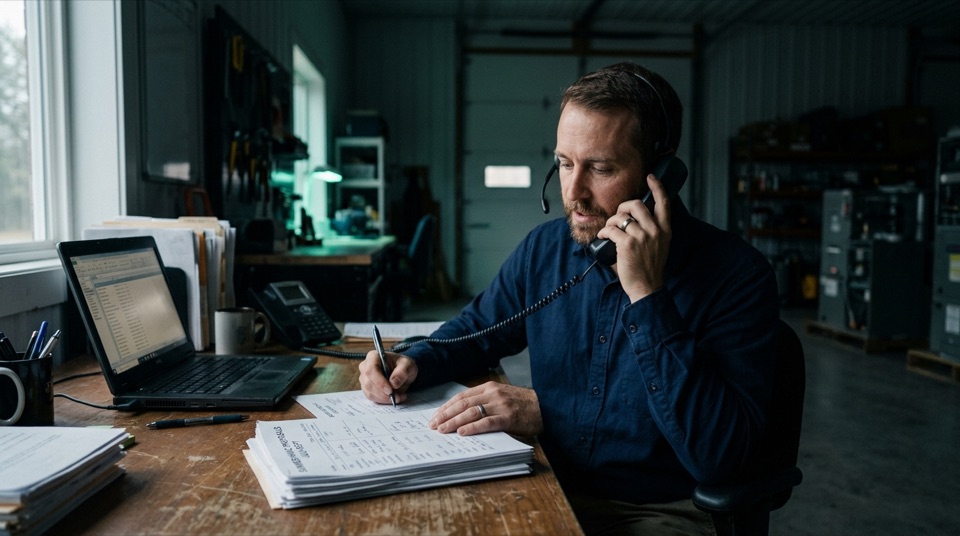
The phones slow down and so does your team
Mid-September. The run of dead systems ends in a week. Your comfort advisors go from four appointments a day to one, sometimes none. They come in late, do paperwork, and wait for the dispatcher. By November the sharpest advisor you had in July is rusty, and the newest one has forgotten half of what the summer taught him. Then a cold snap hits, furnaces fail, and the leads arrive to a team that has not presented a price in weeks.
You see it as a slow fall and a slow start to heating season. What you are actually looking at is skill decay on a team that stopped doing the reps, plus a stack of summer proposals nobody has called since August. Both are fixable. Neither fixes itself.
Skill decays faster than the season changes
84% of what reps learn in training is gone within 90 days (Sales Performance International). The shoulder season is about 90 days long. An advisor who presents price ten times a week in July is getting reinforcement from the job itself. In October he is not. The words go soft. The pause after the ask gets filled with talking. Financing comes up after the flinch again. None of it is visible to you, because there are so few visits to watch.
Fewer than half of companies reinforce training after paying for it. Most HVAC companies reinforce it by accident, through summer volume, and then let it fade every fall. That is why the same advisors need the same training every spring, and why the first weeks of heating season are always slower than they should be.
Job one: practice every day, whether or not the phone rings
When the calendar is empty, the calendar is the practice schedule. One 20-minute lesson per advisor per weekday, workbook and quiz so completion is real, then role play against a simulated homeowner on the objection the lesson covered. The heating-season objections belong here. "The furnace is only twelve years old." "Can you just get it running until spring?" "I want to see how the winter goes first." Have the advisor run each one at the hardest difficulty in October so the real version in December feels easy.
In Revenue OS the practice is an AI homeowner by text or live voice, 5 personas plus custom ones built on your market, 3 difficulty levels, scored in about 60 seconds on script adherence, objection handling, close attempt, energy and tone, and follow-up setup, 20 points each, with a coach's note. 70 clears. Three under 60 in a row open a manager enforcement action. That last rule matters most in the slow season, because an advisor with nothing on the calendar can skip practice for a month and nobody notices unless something notices for you.
- One lesson per weekday, workbook and quiz
- Role play the heating objections at the hardest difficulty
- Score every attempt; 70 clears
- Enforcement opens on its own when scores slide
Job two: work the summer proposals
Pull every replacement proposal from June through September that did not close. In most companies that list is longer than the fall lead flow. Each name on it is a homeowner who already had your tech in the house, already saw a price, and already knows the system is failing. 80% of sales are made between the 5th and 12th follow-up attempt, and 48% of salespeople never follow up at all (from the Million Dollar Follow-Up course). Most of the proposals on that list got one call.
Give the list to the advisors with a sequence, not a suggestion. The words for each touch, the spacing, and a reason for each call that is true in your market: install crews are open, the system that limped through August still has the same failure, the first cold night is coming. An advisor with an empty afternoon and twenty summer proposals has a full afternoon.
When a proposal has gone quiet and the advisor is out of ideas, describe the deal to the Deal Helper in Revenue OS and get three named follow-up plays with the exact words and why each one works. The outcome is logged. By the end of the fall the log shows which plays re-open summer proposals in your market and which ones do not, per advisor.
Record the few visits you do have
Fewer visits does not mean less to learn. It means each visit matters more. Record every fall visit with the homeowner's consent, from the advisor's phone, and score it against your written process on six skills plus your own process at 60% weight, with the best and worst moment timestamped. With one or two visits a day there is time to coach every one of them. A visit under 80 becomes a redo due 6pm the next business day against an AI homeowner seeded with the real homeowner's words. The advisor who talked through the silence on Tuesday practices the pause on Wednesday.
73% of sales managers spend under 30 minutes a week coaching a rep (ATD 2025, Gong 2025). In July that half hour is impossible. In October it is not. A coaching queue sorted by urgency puts the manager's half hour on the one moment that needs it, instead of on a general talk about staying motivated.
What the owner watches in the fall
One Compliance Score per advisor, nightly, 0 to 100: training completion 30%, daily tasks 25%, role play quality 25%, manager enforcement 20%. In the summer that number tells you whether the team is keeping up. In the fall it tells you whether the team is doing anything at all. An advisor who has cleared the practice bar every day and worked his proposal list shows above the line. One who has been waiting for the dispatcher shows below it, and the score says which piece slipped.
AireServ of the Coastal Bend runs the system. The slow season is what a daily loop is built for, because the calendar cannot provide the reps and something else has to. Use the fall to get better instead of rusty, call the proposals that walked, and the first cold snap is where you break your revenue record.
The short version
- The shoulder season is about 90 days, which is how long it takes most training to fade; a team that stops practicing in September is rusty by the first cold snap.
- When the calendar is empty, the calendar is the practice schedule: one lesson and one scored role play per advisor per weekday.
- The summer proposals that did not close are a bigger list than the fall lead flow; work them with a written sequence, not a suggestion.
- Fewer visits means every visit can be coached; record and score each one and redo the misses the next morning.
- A nightly score per advisor shows who is practicing and working the list, and who is waiting for the dispatcher.
Questions owners ask
How do HVAC companies keep comfort advisors productive when leads slow down in the fall?⌄
Give them two daily jobs that do not depend on the phone. First, a short lesson and a scored role play on the heating-season objections every weekday. Second, a written follow-up sequence on every summer proposal that did not close. Between the two, an advisor with one appointment on the calendar still has a full day, and he walks into heating season sharp.
Is it worth calling back summer HVAC proposals in October?⌄
Yes. Each one is a homeowner who already had your tech in the house, saw a price, and knows the system is failing. Most of them got a single call. Most sales happen well past the fifth follow-up. Give each touch a true reason, such as open install crews or the coming cold, and the list becomes the best lead source you have in the fall.
How can an owner tell whether advisors are actually practicing during the slow season?⌄
Do not ask. Look at a number. A nightly score per advisor that counts training completion, daily tasks, role play quality and manager enforcement shows who cleared the practice bar and who skipped it. Pair it with the scores on the few real visits that did happen and you know who will be ready for the first cold snap and who will not.
See how the system runs in HVAC.
Revenue OS for HVACYour best month ever, and the plan to beat it.
Break Your Revenue Record