
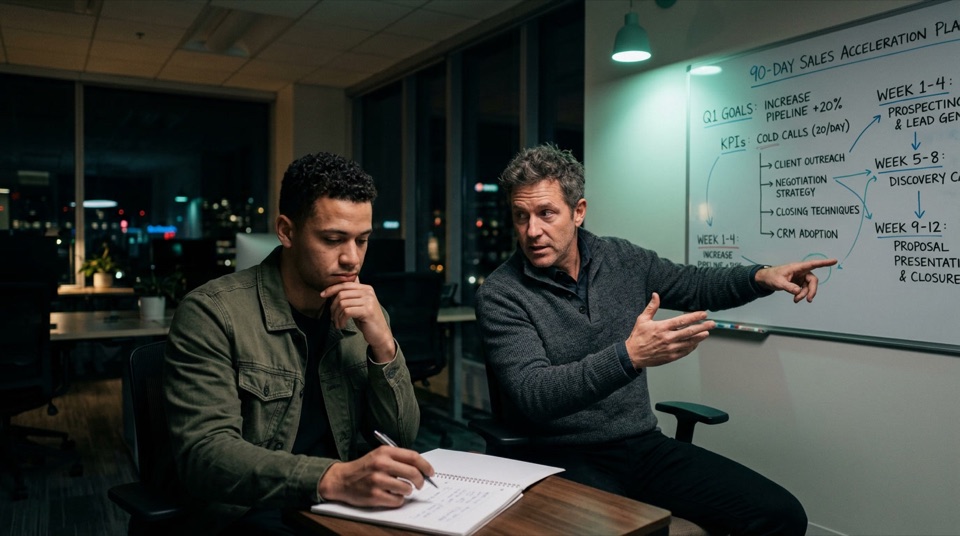
You paid for training and nothing changed
You know the feeling. You brought in a trainer or bought a course. The room was fired up for two days. Reps swore they would run the new approach. Three weeks later you rode along on a call and heard the same pitch you heard last year. The price objection came up and the rep folded. The follow-up never happened. The invoice for the training is the only lasting evidence it took place.
This is not a reflection of your reps or of the trainer. It is what happens when a skill is introduced and never rehearsed. Nobody learns to swing a hammer by watching a video about hammers. Sales is the same. A rep who hears a rebuttal once and never says it out loud under pressure will not say it when a homeowner is standing at the door with three other quotes.
Fewer than half of companies reinforce training after paying for it, and only 29% of companies can see whether training changed what their reps do. So most owners are paying for events, not for changed behavior, and have no way to know the difference until the month closes short.
Why the lesson fades within 90 days
Three things kill training in the field. First, no repetition. A rep hears the new approach once. The old habit has been rehearsed thousands of times on real customers. The old habit wins. Second, no pressure test. A conference room is safe. A kitchen table with an angry spouse is not. Skills that were never practiced under pressure disappear under pressure. Third, no feedback. The rep tries the new approach once, it feels awkward, nobody tells them they did it right, so they stop.
There is a fourth cause that owners rarely name: nobody is watching. If your reps know that nobody will ever check whether they used the training, most will not use it. This is not laziness. It is human. People do what gets measured and skip what does not. If your only measurement is closed revenue at the end of the month, the rep can hit the number the old way and you will never see the training was abandoned.
- Heard once, never rehearsed
- Never tested under real pressure
- No feedback on the first attempts
- Nobody checking whether it is used
What has to be added: the closed loop
Training holds when it runs as a loop instead of an event. The loop has four stages and one instrument. Learn: a short lesson on one specific skill, small enough to use today. Practice: the rep says the words out loud against a realistic customer before a real one. Implement: the rep uses the skill on real customers, and someone can hear whether it happened. Refine: the gap between the practice and the real call becomes the next lesson. The instrument is a score every rep can see.
The loop works because each stage feeds the next. A lesson on the price objection is followed by role play on the price objection, then by a real call where the price objection comes up, then by a review of that moment that shows exactly where the rep drifted. The rep goes back to practice on that exact drift. Nothing is learned in the abstract. Everything is learned against the customers your reps actually face.
Revenue OS is built as this loop. The Sales Academy delivers Jordan Stupar's method as a 90-day plan, one 20-minute lesson per rep per weekday, with a workbook and quiz after every lesson so completion means something. Month one is objections, month two follow-up, month three ticket and pricing. Each lesson is followed by role play against an AI customer, and real calls are scored against the same skills the lesson taught.
Why a visible score is the part most owners skip
Owners will buy the lessons and even set up practice. Almost nobody adds the score. Yet the score is what turns training from optional into expected. When every rep can see a number that reflects whether they did the lesson, ran the practice, and used the skill on real calls, the question of whether to do the work stops being a question. Reps do not want to be last on a list their peers can see.
The score should measure behavior, not just results. Results lag. A rep who stopped doing the work in week two will still close deals from old pipeline in week six, and the revenue number will hide the problem until it is expensive. Behavior shows up the same day. Did the rep complete the lesson? Did they run the role play and clear the bar? Did the real call hit the process? Those questions have answers tonight.
In Revenue OS this is the Compliance Score: one number per rep, 0 to 100, updated nightly. Training completion counts 30%, daily tasks 25%, role play quality 25%, and manager enforcement 20%. Reps see their rank. Owners see who is doing the work without pulling a single report or riding along on a single call.
How to run the loop this week
Pick one skill. Not a program, one skill. For most teams that skill is the price objection, because it is the moment where the most revenue leaks. Give the team a 20-minute lesson on it Monday. Tuesday, every rep runs the objection out loud three times against a realistic customer and gets a score. Wednesday through Friday, the skill is used on real calls, and those calls are reviewed for that one moment.
Publish the results Friday. Who completed the lesson, who cleared the practice, whose real calls held the process. Make it visible to the whole team. Then repeat with the next skill next week. In 90 days you will have covered the method one skill at a time, and each skill will have been rehearsed, used, corrected, and measured. That is training that holds. Anything less is an event with an invoice.
The short version
- Training fails within 90 days when it stops at the lesson and nobody rehearses, uses, or measures the skill.
- The fix is a closed loop: learn, practice, implement, refine, with a visible score that reports behavior nightly.
- Measure behavior, not just revenue, because revenue lags the moment a rep quietly abandons the training.
- Run one skill per week, publish the results to the team, and repeat for 90 days.
Questions owners ask
How long does it take for sales training to fade if it is not reinforced?⌄
Most of it is gone within three months. 84% of what reps learn in training is gone within 90 days (Sales Performance International). The decay starts in the first week, when the rep faces a real customer and falls back on the old habit because it was rehearsed thousands of times and the new skill was rehearsed once.
What is the single most important thing to add to make sales training stick?⌄
A visible score that measures behavior, not results. Practice and real-call review matter, but without a number the team can see, both become optional and drift away. The score should reflect whether the lesson was completed, whether the rep practiced and cleared the bar, and whether real calls followed the process.
Can a small team with no sales manager make training hold?⌄
Yes, if the loop is automated. A 20-minute daily lesson, an AI customer for practice, scored real calls, and a nightly score per rep can run without a full-time manager. The owner spends ten minutes a day looking at who is doing the work instead of hours running training sessions.
Your best month ever, and the plan to beat it.
Break Your Revenue Record