
You cannot listen live, so you do not coach
The honest version of coaching in most agencies: you sit next to a producer for an hour twice a year, hear them run the call the way you taught them because you are sitting there, and say good job. The rest of the year, coaching is whatever happens after a customer complains or a big quote is lost. That is coaching the worst call of the quarter, not the average one.
It is not a discipline problem. You run the agency. Carrier calls, claims, staffing, the books. Live listening takes an hour to find one coachable moment, and you do not have the hour. So the producer who reads quotes and hangs up has been doing it for two years and nobody has told them, because nobody heard it.
Only 29% of companies can see whether training changed what their reps do. Live listening is why. It does not scale to one owner and a team, so it does not happen, so the training you paid for goes unverified.
Recorded and scored beats live every time
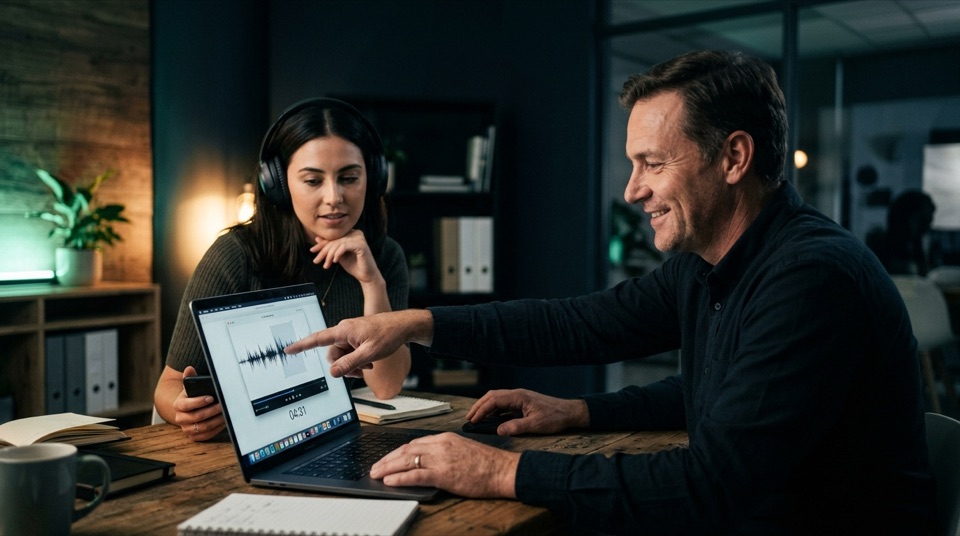
A recorded call can be scored without you. A scored call can be sorted. A sorted list tells you where to spend the 30 minutes. That chain is the whole method. In Revenue OS the Intel Suite records with consent, transcribes and scores every real conversation, from the producer's phone in person, an upload or a Zoom review, on six skills: value stacking, objection handling, close timing, price presentation, follow-up setup and talk-to-listen ratio. Your own written process is scored at 60% of the weight. Each call gets a number, a best moment and a worst moment, both timestamped.
You never start at minute zero. You open the call at minute six, where the customer said the other carrier was lower and the producer went to discounts. Thirty seconds of audio. You know exactly what to say.
Recording is initiated by your agency and you own consent, including in all-party states. Audio is deleted after 90 days and no voiceprints are created. Confirm your own disclosure with counsel, then record everything, because a sample only tells you about the sample.
The 30-minute week
Monday, ten minutes. Open the coaching queue, sorted by urgency: lowest scores, most misses on one step, redos not done. Pick the two or three calls that matter. Do not read the rest.
Two coaching conversations, eight minutes each. Play the timestamped moment for the producer. Ask what they heard. Name the one thing to change. Assign the practice: a persona who says the same thing, run until it clears 70. Set when you will look at the next real call on that skill. That is a coaching conversation with a beginning, a fix and a follow-up, and it fits in eight minutes because the moment is already found.
Friday, four minutes. Check that the redos were done and see whether this week's scores on that step moved. If they did, say so. If they did not, the same producer is at the top of Monday's queue.
- Monday: open the queue, pick two or three calls, ten minutes
- Two eight-minute conversations off the timestamp, each with a practice assignment
- Friday: confirm the redos and check the step, four minutes
Let the system run the redo so you do not have to
The reason coaching does not stick is that the fix is never practiced. The producer agrees, goes back to the phone and does the same thing on the next call. A call under 80 becomes a redo due 6pm the next business day, against an AI customer seeded with the real customer's words. The producer runs the lost call again, scored in about 60 seconds on five criteria with a coach's note. You did not schedule it or chase it. You see whether it happened, and that feeds the manager enforcement piece of their score.
Three practice scores under 60 in a row open a manager enforcement action. That is the system telling you which producer needs the conversation before you go looking. Your 30 minutes get pointed by the data, not by whoever complained last.
Coach the pattern, not the person
After a month the queue shows patterns. Four producers miss the second-policy question. One producer never sets a next step. One has a talk-to-listen ratio that says they are lecturing. The first is a team lesson; the Sales Academy inside Revenue OS has 140 lessons and next Monday's 20 minutes can be the one on value stacking. The second is a habit, fixed with a persona run ten times before the phones open. The third is a single conversation with a clip.
A nightly Compliance Score per producer, 0 to 100, tells you who is doing the work: training completion 30%, daily tasks 25%, role play quality 25%, manager enforcement 20%. Pair it with the call scores and you know who performs, who is trying and who is skipping. That is the whole picture, and it takes no ride-along.
What 30 minutes buys
State Farm agents run this system. The change is not that you coach more. It is that every minute lands on a real moment from a real call with a fix and a practice session attached. Producers stop hearing "sell the value" and start hearing "minute six, here is the question." Over a quarter that is the bind rate on the leads you already buy moving one step at a time, which is how an owner with no spare hours breaks the agency's revenue record.
The short version
- Live listening does not scale to one owner and a team, which is why coaching in most agencies rounds to zero.
- Score every recorded call, sort by urgency, and open only the two or three that need you, at the timestamp.
- Every coaching conversation ends with one fix and a practice assignment the system tracks.
- After a month, coach the patterns: team lessons for shared gaps, personas for habits, a clip for the one-off.
Questions owners ask
How much time should an agency owner spend coaching producers each week?⌄
Thirty minutes is enough if every minute lands on a real moment. Ten minutes to pick the two or three calls from a queue sorted by urgency, two eight-minute conversations off the timestamp with a practice assignment each, and four minutes on Friday to confirm the redos were done. The hours disappear when the moment is already found.
Is it better to coach from recorded calls or listen live?⌄
Recorded and scored. Live listening takes an hour to find one coachable moment and producers run the call differently when the owner is beside them. A recorded call scored against your process gives you the number, the worst moment and the timestamp without anyone listening to the whole thing, so you coach the average call, not the one you happened to catch.
What should a coaching conversation with a producer look like?⌄
Play the timestamped moment. Ask what they heard. Name the one thing to change. Assign a practice session against a customer who says the same thing, to be run until it clears. Set when you will look at the next real call on that skill. Eight minutes, one fix, one follow-up. Anything longer is a lecture, and lectures fade.
See how the system runs in Insurance.
Revenue OS for InsuranceYour best month ever, and the plan to beat it.
Break Your Revenue Record