
The objection that does not sound like one
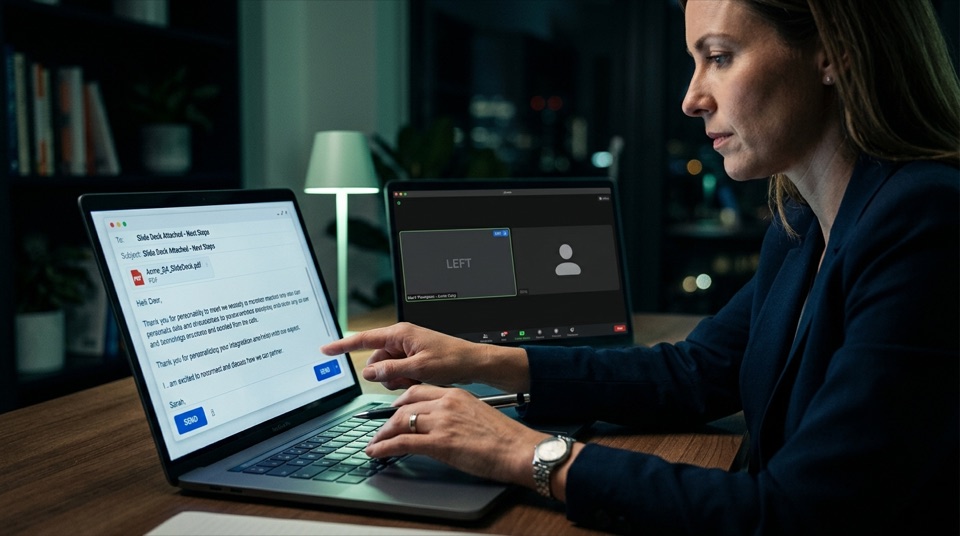
Your AE finishes a demo. The prospect says "this is great, send me the deck and we will circle back internally." The AE says "absolutely, that goes out today," sends a recap and a PDF, and logs the deal as progressing. Two weeks later the AE sends a "just checking in" email. Then another. The deal stays in stage three until the AE pushes the close date or the manager cleans up the pipeline. Nobody calls it an objection, so nobody handles it.
Look at how many deals in your pipeline are sitting on exactly this sentence. It is the most common stall in SaaS, and it is the most polite, which is why it works. It gives the AE something to do. It gives the prospect an exit. It ends the meeting on a friendly note. And it moves nothing. If your AEs are hearing this on a quarter of their demos and accepting it every time, that is where the cycle is getting long.
What the prospect is actually saying
The words are neutral. The meaning is not. Usually the prospect means one of four things. The champion likes it but does not have the authority to say yes and does not want to admit it. Something in the demo raised a concern the prospect did not want to voice on the call, often price or a missing feature. There is a competing option and the prospect wants to compare quietly. Or the problem is real but not urgent, and the deck is a way to park it.
Each of those needs a different response, and none of them is fixed by a PDF. The deck cannot answer the concern the prospect did not voice. The deck cannot get the VP into the room. The deck cannot make the problem urgent. The only thing that can do any of those is the AE, on the call, asking one more question before agreeing to anything. That question is where the deal is either kept or lost.
- No authority: the champion cannot say yes alone
- Unvoiced concern: usually price or a gap in the product
- Quiet comparison: another vendor is in the mix
- Low urgency: the problem is real but parked
The words that keep the deal alive
Acknowledge first. "Happy to send that." Then find out what is behind it, without accusing. "So the deck is useful for the right people, who is going to be looking at it?" That surfaces the buying group. "When you say circle back, what is the conversation that has to happen on your side?" That surfaces the process. "Is there anything you saw today that gave you pause?" That surfaces the unvoiced concern. One of those questions will land, and the answer is the real objection.
Then offer something better than a PDF. "Rather than send a deck that has to speak for itself, would it help to walk your VP through the two things you said matter most, in fifteen minutes, on Thursday?" A deck gets skimmed and forwarded without context. A short call with the second stakeholder is a meeting the AE controls. If the prospect declines, that is information too, and it is better to have it now than in six weeks.
Close on a date. Not "the follow-up goes out next week," which is the AE's task, but "put fifteen minutes on the calendar for Thursday as a checkpoint, and cancel it if it is not needed." A date on the prospect's calendar is a commitment. A follow-up in the AE's CRM is a hope. Accepting the stall without a date is the moment the AE loses the deal, and it happens on the call, not in the weeks after.
Why AEs fold on this one
AEs accept this stall because pushing back feels rude. The prospect was friendly. The demo went well. Asking "what is really behind that" feels like calling them a liar. So the AE takes the easy yes and tells themselves the deal is moving. Reps do not need to be told this is wrong. They know. They need to have said the better words out loud enough times that the words come out under pressure.
That is a practice problem, and it has a practice solution. Put the AE in front of an AI buyer who ends the demo with "send me the deck and we will circle back," and have them handle it ten times before Friday. Customer AI & Role Play does this by text or live voice, across 5 personas plus custom and 3 difficulty levels. Each run is scored in about 60 seconds on five criteria at 20 points each, including objection handling and follow-up setup, with a coach's note. A 70 clears. Three under 60 in a row open a manager enforcement action.
How to see it happening on real demos
You cannot fix a habit you cannot see. When real demos are recorded and scored, the stall shows up as a timestamped worst moment: minute 41, prospect asks for the deck, AE agrees, no next meeting set, follow-up setup scored low. That is a five-minute coaching conversation, and it points to a specific sentence rather than a vague instruction to "push harder on next steps."
Revenue OS scores tagged Zoom demos on six skills including close timing and follow-up setup, plus your own process at 60% weight, and syncs to HubSpot. A demo under 80 becomes a redo due 6pm the next business day against an AI buyer seeded with the real prospect's words. When the deal is already stalled, Deal Helper takes a description of it and returns three named follow-up plays with exact words and why each works, so the follow-up email says something better than "just checking in."
The rule to give your team this week
No deal leaves a demo without a date and a name. If the prospect wants the deck, they get it, and they also get a fifteen-minute checkpoint on the calendar with the person who will read it. Write that rule into your sales process so it is scored on every call. Then drill the words until every AE can say them without flinching. The polite stall will keep coming. The difference is whether your AEs have an answer for it or a PDF.
The short version
- "Send me the deck and we will circle back" is a polite no. Treat it as an objection, not a next step.
- It usually hides one of four things: no authority, an unvoiced concern, a quiet comparison, or low urgency.
- Acknowledge, ask what is behind it, offer a short call with the second stakeholder, and close on a date.
- AEs fold because pushing back feels rude. Fix that with repetition against a realistic buyer, not a reminder.
- Score real demos on follow-up setup so the stall shows up as a timestamped moment you can coach in five minutes.
Questions owners ask
Should an AE refuse to send the deck?⌄
No. Refusing feels combative and gains nothing. Send the deck, but not by itself. Ask who will be reading it and what conversation has to happen internally, then offer a short call with that person and put a date on the calendar before the demo ends. The deck becomes a companion to a scheduled meeting instead of a substitute for one.
What if the prospect will not commit to a next meeting?⌄
That is useful information. A prospect who will not put fifteen minutes on the calendar is telling the AE the deal is not real yet. Ask directly what would need to be true for it to be worth a next conversation, log the answer, and move the deal to the right stage instead of leaving it in stage three. A clean pipeline is worth more than a hopeful one.
How do I train AEs to handle this stall without sounding pushy?⌄
Give them the exact words, framed as help rather than pressure, and have them practice against an AI buyer who raises the stall until the words are automatic. Then score real demos on follow-up setup so the moment shows up with a timestamp. Coach that one moment. Tone improves with repetition, and repetition happens in practice, not on a live prospect.
See how the system runs in SaaS.
Revenue OS for SaaSYour best month ever, and the plan to beat it.
Break Your Revenue Record