
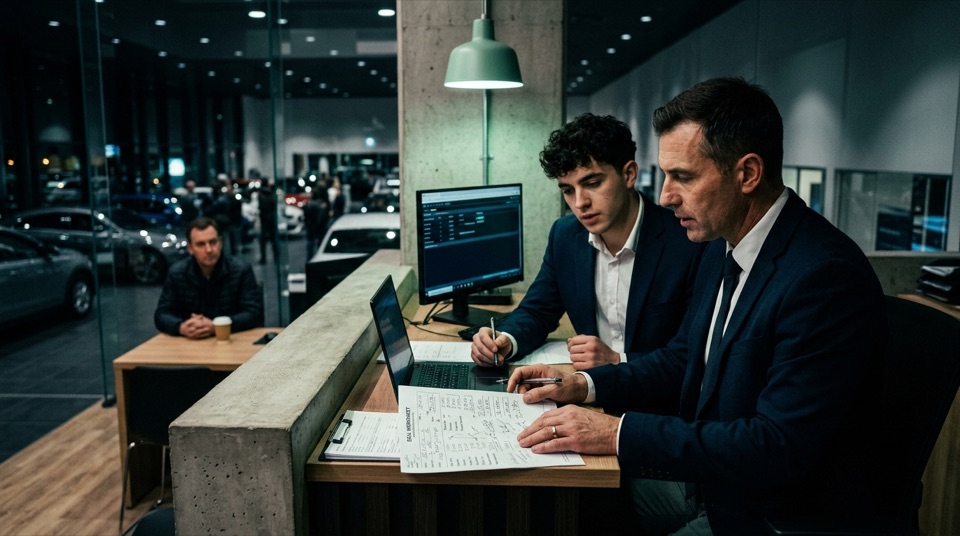
Every objection ends with a discount
Look at your deal log. The first pencil went out. The customer said the payment was too high. The salesperson went back to the desk and said, "They need to be at four hundred." The desk found a way. The deal closed, and it closed for six hundred less front-end gross than the pencil. Multiply that by the month. That is not a customer problem. That is a salesperson who had one move.
The habit is expensive because it is invisible in the moment. The deal closed. The salesperson got a unit. The desk kept the customer from walking. Everyone did their job and the store made half of what it should have. Nobody hears the conversation where the salesperson could have held the number and did not.
Gross is lost before the pencil, not at it
By the time the customer sees numbers, the deal is either built or it is not. If the salesperson knows what the customer is paying now, what the trade is costing them in repairs, why they need the car this month, and what it has to do for their family, the payment has context. It is a difference from what they already spend, not a number in a vacuum. If the salesperson knows none of that, the payment is just a number, and the only response to "too high" is a lower number.
The walkaround does the same work on the value side. A customer who has been shown, in terms that matter to them, why this specific vehicle solves their specific problem argues less about the payment. A customer who drove a car and was never sold on it argues about nothing else. The desk is asked to make up with dollars what the salesperson did not do with questions.
So the gross conversation is really a road-to-the-sale conversation. The steps your salespeople skip on a busy Saturday are the steps that would have held the number.
Presenting the price so it holds
The price presentation is a skill, and most salespeople have never been taught it. They slide the worksheet across the desk and wait. Silence, then the objection. A trained salesperson presents the numbers with the value already attached: what the customer said they wanted, what this vehicle does about it, what they are paying today, and then the payment. Presented with confidence, in that order, the number lands differently.
Then the objection comes anyway, because it always does. The trained response is not a trip to the desk. It is a question. "When you say too high, is it the payment itself, or where it sits against what you are paying now?" Then the salesperson uses what they learned on the lot. Only after the real concern is understood does the desk get involved, and now the desk knows what it is solving.
The words vary by store, but they have to be rehearsed. A salesperson who has said them fifty times says them at the desk. One who read them in a meeting goes to the desk and asks for four hundred.
- Restate what the customer said they needed
- Tie the vehicle to it in their words
- Frame the payment against what they pay today
- Ask what "too high" means before going to the desk
Drill the payment objection every morning
The payment objection is the most predictable moment in the dealership sale. It is also the one salespeople practice least. Fewer than half of companies reinforce training after paying for it. A quarterly meeting on holding gross changes nothing at the desk in week six.
Ten minutes a morning does. In Revenue OS the salesperson runs the payment objection against an AI buyer by text or live voice, choosing from 5 personas plus custom at 3 difficulty levels, and gets a score in about 60 seconds on script adherence, objection handling, close attempt, energy and tone, and follow-up setup, 20 points each, with a coach's note. A 70 clears. Three under 60 in a row open a manager enforcement action. The green pea practices the easy buyer. The veteran practices the one with three quotes on his phone.
Month three of the training plan is ticket and pricing, which in a dealership means gross: presenting the price with confidence, holding it through the first objection, and handling the customer who saw it cheaper online. That is one 20-minute lesson per weekday, with the role play on that day's lesson, so the words and the practice arrive together.
Hear the conversation where the gross went
The desk sees the pencil request. It does not hear what the salesperson said in the ninety seconds before it. Recording desk conversations with consent and scoring them changes that. Price presentation is one of six scored skills, alongside value stacking, objection handling, close timing, follow-up setup, and talk-to-listen ratio. Your own road to the sale is scored at 60% weight. The best and worst moment are timestamped.
In Revenue OS a conversation under 80 becomes a redo due 6pm the next business day, against an AI buyer seeded with the real customer's words. The salesperson who folded on Saturday hears the same "too high" on Monday and answers with a question instead of a trip to the desk. Managers get a coaching queue by urgency and see which objections the floor loses most. If it is the payment objection, you know what next week's lesson is.
What changes when the floor can hold a number
The desk stops being the only tool. Salespeople come back with information instead of a demand. Deals close closer to the first pencil. The customers who were going to buy anyway stop getting six hundred dollars they never asked for. And the customers who genuinely need help on payment get it, because the desk is no longer spending its room on deals that did not need it.
Start with the road to the sale, because that is where gross is built. Then teach the price presentation and drill the payment objection daily. Then hear the real conversations and coach the moment, not the month. Toyota of Katy runs this system. Holding gross on the traffic you already have is the shortest path to breaking your revenue record.
The short version
- Gross is lost on the lot when the needs assessment and walkaround are skipped, and surrendered at the desk because the salesperson has nothing else to offer.
- Teach the price presentation: value first, payment framed against what the customer pays today, then a question before any trip to the desk.
- Drill the payment objection every morning against a buyer who pushes back, not once a quarter.
- Score real desk conversations on price presentation and your own process so the moment gross went is timestamped and coachable.
Questions owners ask
Why do car salespeople drop gross so quickly at the desk?⌄
Because it is the only move they have. If the needs assessment and walkaround were skipped, the payment is a number with no context, and the only answer to "too high" is a lower number. A salesperson who built the deal on the lot can frame the payment against what the customer pays today and ask what the objection really means before involving the desk.
What should a salesperson say when the customer says the payment is too high?⌄
Ask before you discount. "When you say too high, is it the payment itself, or where it sits against what you are paying now?" Then use what was learned in the needs assessment: the repair costs on the trade, the reason they need the car this month, what they said it had to do. The desk gets involved only after the real concern is clear.
How do I train a whole floor to hold gross without a full-time trainer?⌄
Run it as a daily loop. One 20-minute lesson before the floor opens, ten minutes of scored role play on the payment objection, and real desk conversations recorded with consent and scored on price presentation. Managers coach from a queue that already marks the moment. It takes about 30 minutes a day per salesperson and no outside trainer.
See how the system runs in Car Sales.
Revenue OS for Car SalesYour best month ever, and the plan to beat it.
Break Your Revenue Record