
The discount nobody asked for
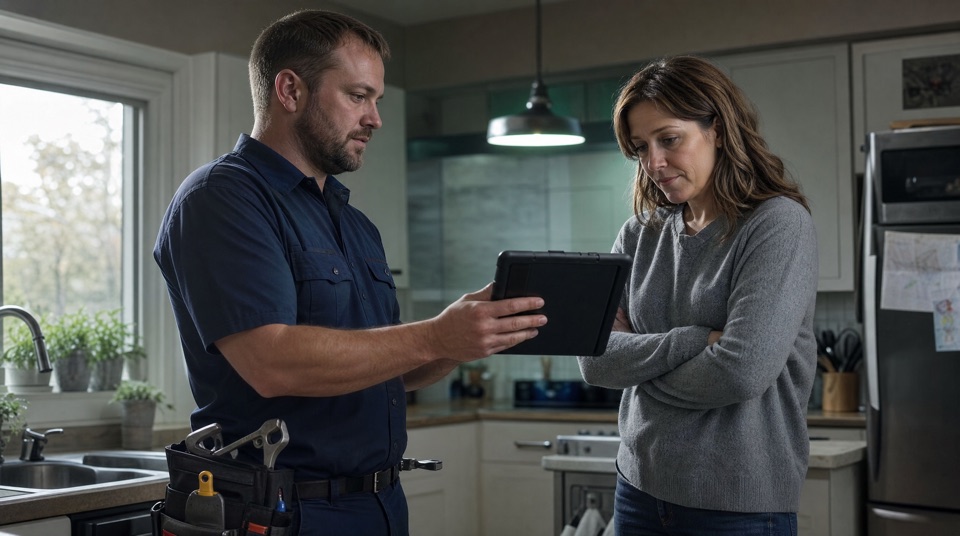
Ride along for a day and you will hear it. The tech finishes the diagnosis, presents the repair at $1,180, and the homeowner says nothing. Three seconds of quiet. The tech fills it: "and I can probably do a little better on that for you." The homeowner had not objected. They were doing arithmetic in their head, or thinking about where the dog was. The tech read the pause as a no and paid a hundred and fifty dollars to make it go away.
That is the discount that hurts most, because it is invisible. You can see a discount a customer negotiated for, and you can usually justify it. The unprompted one leaves no trace. The invoice looks normal. The customer is happy. The tech thinks they saved the job. Nobody, including the tech, can tell you it happened, so it happens again on the next call and the one after that.
What it actually costs you
Do the arithmetic on your own numbers before you decide this is a small problem. Take your average ticket, take the discount your techs give when they give one, and take an honest guess at how often it happens. Most owners who run that math for the first time land on a figure that is larger than the raise they were arguing about at the last manager meeting.
There is a second cost that is worse than the first. A tech who discounts to end discomfort is a tech who has learned that price is the lever. The next time a job is hard to sell, they will reach for the same lever. Over a year, that tech builds a book of customers who expect a discount, and they train the customer base right along with themselves. Your price list stops being your price list and becomes an opening bid.
- Price dropped before the customer said a word about it
- "Let me see what I can do" offered as an opener, not a response
- The option sheet presented with the cheapest option on top
- A membership thrown in free instead of sold
Why telling them to stop does not work
Every owner reading this has already had the meeting. You put the margin slide up, you explained what a point of gross costs, everybody nodded, and three weeks later the invoices looked exactly the same. 84% of what reps learn in training is gone within 90 days (Sales Performance International), and a meeting about margin is training whether you call it that or not.
It does not hold because discounting is not an information problem. Your techs know the price. They know you do not want them cutting it. What they do not have is a rehearsed thing to do with their mouth during three seconds of silence in a stranger's kitchen. Absent a better habit, they will reach for the one that works: lower the number. You cannot instruct your way out of a reflex. You have to replace it with a different reflex, and that takes repetition.
The silence is the skill
The specific skill is short and teachable: present the price, then stop talking. Present two options, recommend one, give the number, and let the customer respond first. Most techs have never once done this on a real call. They have no idea what happens on the other side of the pause, because they have never let the pause finish.
Customer AI & Role Play lets a tech find out somewhere safer than a customer's house. They practice against an AI homeowner by text or live voice, across 5 personas plus custom and 3 difficulty levels, and every attempt comes back scored in about 60 seconds on five criteria: script adherence, objection handling, close attempt, energy and tone, and follow-up setup, 20 points each, with a coach's note. A 70 clears. A tech who has sat through that silence thirty times in practice can sit through it once in a kitchen.
Then check whether it held on the real call
Practice only counts if it shows up on the truck. Intel Suite records, transcribes and scores real service calls against six skills, including price presentation and close timing, and syncs the result so the score lives with the job. Your own process carries 60% of the weight, so if your standard is two options presented with one recommended and the price given without a qualifier, a call that opened with "I can probably do better" scores lower and you can see which tech it was.
A call under 80 becomes a redo due 6pm the next business day, re-fought against an AI customer seeded with the real homeowner's actual words. The tech does not rehearse a generic price objection. They rehearse the exact moment they folded, in the words the customer used, the day after it happened, while it still stings enough to matter.
One number that shows you who holds price
The Compliance Score is one number per tech, 0 to 100, recalculated nightly: training completion 30%, daily tasks 25%, role play quality 25%, manager enforcement 20%. Your dashboard ranks the team, sorts a coaching queue by urgency, and shows the objections your techs lose most. Three role play scores under 60 in a row open a manager enforcement action, so the tech who is quietly avoiding the practice cannot stay quiet about it.
You are not trying to turn plumbers into closers. You are trying to make sure the price you set is the price that gets charged, and that a tech who is uncomfortable has something better to reach for than your margin. That is how a plumbing company breaks its revenue record without adding a truck.
The short version
- Most discounting is unprompted: the tech reads a pause as rejection and cuts the price nobody objected to.
- It is invisible in your reporting, which is why it compounds. The invoice looks normal and the margin drifts.
- A margin meeting will not fix it, because discounting is a reflex under discomfort, not a gap in information.
- The skill is presenting the price and stopping. It has to be rehearsed before it can survive a real kitchen.
- Score price presentation on real calls and turn every fold into a redo seeded with the customer's own words.
Questions owners ask
How do I know how much my techs are discounting?⌄
Compare the priced option against what was invoiced, per tech, over 30 days. Most plumbing companies have never run this by technician and are surprised by the spread. Scoring the calls themselves adds the part the invoice cannot show you: whether the customer ever objected, or the tech dropped the price into silence.
Should techs be allowed to discount at all?⌄
Give them one defined tool with a boundary you set, such as a membership that carries a stated value, and make everything else a manager approval. The problem is not that a discount exists, it is that an undefined discount becomes the first move instead of the last one. A tech with one approved tool does not need to invent one.
Will scoring calls make my techs feel policed?⌄
It goes the other way when the score is attached to coaching instead of discipline. Techs dislike being told they are soft on price with no evidence and no help. A timestamped moment, a rehearsal against the same objection, and a score that moves is specific and finite. The tech can see what to fix and see it clear.
See how the system runs in Plumbing.
Revenue OS for PlumbingYour best month ever, and the plan to beat it.
Break Your Revenue Record