
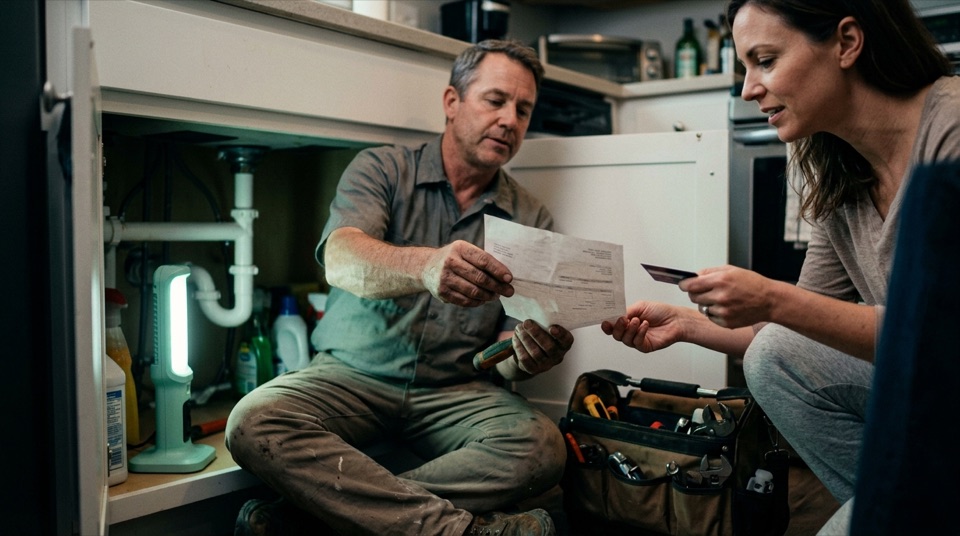
The tech fixed the leak and left a $9,000 repipe behind
The call comes in as a dripping faucet. Your tech gets there, fixes it in forty minutes, and while he is under the sink he sees the galvanized supply line, the water heater with rust at the base, and the pressure regulator that is about to fail. He says nothing. Or he mentions it, the homeowner says they will think about it, and he packs up. The invoice is $189. The job in that house was $9,000.
Look at last week's tickets and count how many look like that. A tech who does exactly what the homeowner asked and nothing else is the normal tech in most plumbing companies. He would rather be back in the truck than standing at a kitchen counter talking about options. So the repair-versus-replace conversation never happens, the water heater never comes up, and the homeowner pays the minimum and calls someone else for the big job next year.
The math hurts because the lead and the drive are already paid for by the time he rings the doorbell. Everything above the minimum repair is close to pure margin, and it is walking back to the truck with him.
You already tried the pricing menu and the Saturday class
You built a good-better-best menu. You told the techs to present options every time. Some do. Most present one option, the cheapest, and let the homeowner pick. When the homeowner says another plumber quoted half, your tech drops the price or walks. The big estimates that do go out sit in the CRM as open for weeks, because the tech is on to the next stopped drain and nobody owns the callback.
You also tried training. A sales class, or a trainer for a Saturday, and the average ticket climbed for a month. Then it slid back. That is not a failure of the trainer or the techs. 84% of what reps learn in training is gone within 90 days (Sales Performance International). Fewer than half of companies reinforce training after paying for it. A tech who learned to present options in a classroom is still alone at the counter when the homeowner says "too expensive," and if nobody hears that conversation, nothing changes.
The sale has four steps, and the class only covers one
Training that holds runs as a loop every week, not an event. Learn: one short lesson on one skill. Practice: the tech says the words out loud against a realistic homeowner before a real one. Implement: the tech uses the skill on a real call, and someone can hear whether it happened. Refine: the gap between the practice and the real call becomes tomorrow's lesson. The class you paid for covers step one and stops.
Revenue OS runs the four steps. Learn is the Sales Academy: Jordan Stupar's method as a 90-day plan, 7 courses, 140 lessons, one 20-minute lesson per tech per weekday, with a workbook and quiz after each lesson and a certification per course. Month one is objections: "too expensive," "I will get another quote," "I need to talk to my husband." Month two is follow-up for the open estimates. Month three is ticket and pricing, which for a plumbing company is the whole game.
- Learn: one 20-minute lesson per weekday
- Practice: say the words to a simulated homeowner first
- Implement: real calls recorded and scored
- Refine: the worst moment becomes tomorrow's practice
Practice happens in the app, not in the customer's kitchen
The price objection should be rehearsed dozens of times before a homeowner says it. That used to mean two techs in the break room, one pretending to be a customer and making it too easy. Now it means an AI homeowner the tech talks to by text or live voice. He runs "too expensive" against 5 personas plus custom personas built on your market, at 3 difficulty levels, as many times as it takes.
Every attempt is scored in about 60 seconds on five criteria at 20 points each: script adherence, objection handling, close attempt, energy and tone, and follow-up setup, with a coach's note that names the one thing to fix. A 70 clears. Three scores under 60 in a row open a manager enforcement action. A tech who cannot handle "too expensive" in the app is not ready to handle it standing next to a water heater.
Hear the real call without riding along
The step most owners never get to is the real call. You cannot be in every truck, so the in-home conversation is invisible and the training is unverifiable. Recording changes that. The tech records the visit on his phone with the homeowner's consent, or the office uploads the CSR calls. Every conversation is transcribed and scored on six skills, including price presentation and value stacking, plus your own process at 60% of the weight. The best and worst moment are timestamped so nobody hunts through forty minutes of audio.
A call under 80 becomes a redo due 6pm the next business day, run by voice against an AI homeowner seeded with the real customer's words. The $9,000 estimate that went quiet goes into Deal Helper, which returns three named follow-up plays with the exact words and why each one works, and logs the outcome per tech. The consent side is yours to own: your company initiates the recording and is responsible for consent, including in all-party consent states, audio is deleted 90 days after upload, and no voiceprints are created.
One number tells you who presents options
Refine is a Compliance Score: one number per tech, 0 to 100, recalculated nightly from training completion at 30%, daily tasks at 25%, role play quality at 25%, and manager enforcement at 20%. The dashboard shows the coaching queue sorted by urgency, which objections your techs lose most often, the best and worst moment from every scored visit, and follow-up outcomes per tech. You stop guessing which tech is presenting options and which one is fixing faucets.
Monkey Wrench Plumbing runs the system. It does not change your dispatch, your pricing menu, or your CRM. It makes sure the tech at the kitchen counter has the right words when the homeowner says "too expensive," and that the open estimate gets a real follow-up call. Take your call volume, your average ticket, and your close rate on estimates, and work out what a higher ticket and a working follow-up process would do to your year. That is the number it takes to break your revenue record.
The short version
- Plumbing revenue leaks at the end of the service call, when the tech sees the bigger job and does not present it.
- A pricing menu and a Saturday class cover the lesson only; without practice, scored real calls, and correction, the lift fades in 90 days.
- Techs should rehearse the price objection against a simulated homeowner until the words are automatic, then be scored on the real visit.
- A nightly number per tech shows the owner who presents options without riding along in the truck.
Questions owners ask
Why does the average plumbing ticket drop back after sales training?⌄
Because the training stopped at the lesson. A tech hears how to present options once, then faces a homeowner who says "too expensive" with no rehearsal and nobody listening. The old habit of fixing the leak and leaving wins. Training holds when the lesson is followed by daily practice, scored real calls, and a redo on the moment that failed.
Can a plumbing company record in-home service calls?⌄
Yes, with consent. Your company initiates the recording and is responsible for consent, including in all-party consent states, so the tech states at the door that the visit is recorded for quality and training, the same way the phone line already is. Put the policy in writing with your attorney. Audio should be deleted after a set period and never used for voiceprints.
My techs are plumbers, not salespeople. Will they do daily training?⌄
The load is one 20-minute lesson and a short role play on their phone before the first call. The role play scores in about a minute with a note, so the tech gets a result instead of a lecture. A visible rank against the rest of the team tends to move plumbers more than any pep talk, and the techs already doing the work like being seen doing it.
See how the system runs in Plumbing.
Revenue OS for PlumbingYour best month ever, and the plan to beat it.
Break Your Revenue Record