
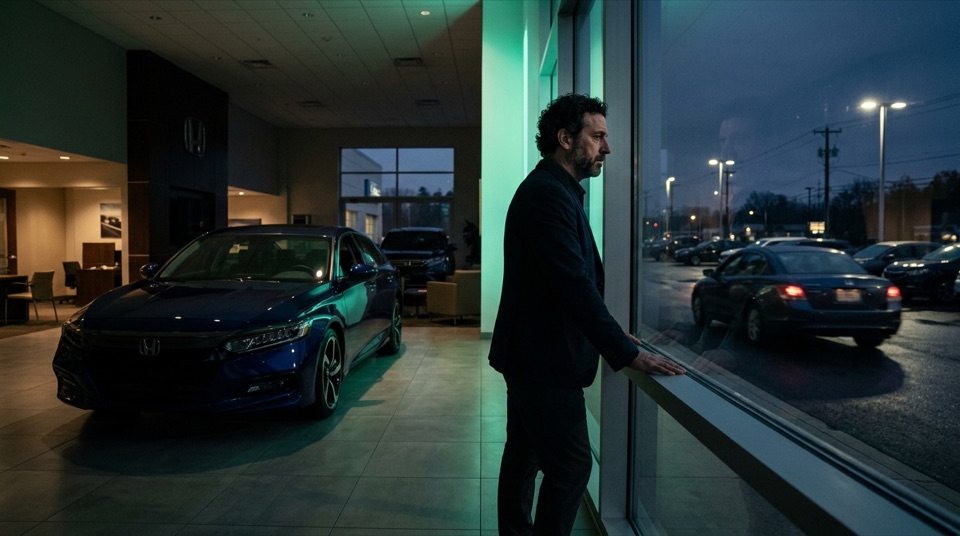
The be-back that never comes back
Here is the deal you lost yesterday. Fresh up, decent credit, drove the car, liked it. The salesperson went to the desk. The first pencil came back and the customer said, "That payment is more than I wanted to be at." The salesperson said he understood, asked what payment they were thinking, went back to the desk, came back with a second pencil, and the customer said, "Let us think about it and come back this weekend." The salesperson gave them a card. The weekend came. They did not.
Meanwhile the internet lead from Tuesday got one templated email and no phone call. The phone-up from Wednesday was logged as working. Your closing ratio on fresh ups sits where it has always sat, and your salespeople blame the desk, the inventory, and the market. None of those things asked the customer a better question. The store across town did.
The leak is on the floor, not at the desk
You know this already. The desk can only work the numbers the salesperson brings back. If the salesperson never found out what the customer is driving now, what the payoff is, why they are shopping this week, and what the payment has to feel like, the desk is pencilling blind. Then the customer objects, the salesperson has nothing to stand on, and the only tool left is dropping gross.
The leak is specific. It is the salesperson who cannot handle "I need to think about it" without giving up gross. The one who never asks for the trade payoff. The one who logs the lead as working and never calls. You cannot be on every deal. Your desk manager sees the numbers but not the conversation. By the time the customer is gone, the conversation is gone with them.
This is why the be-back number is so hard to move. Every fix an owner reaches for, a new CRM, a new lead provider, a new pay plan, sits outside the conversation. The conversation is where the deal died.
Why the Saturday meeting did not fix it
You have run the road-to-the-sale meetings. You have brought in the Saturday morning trainer. You have put the team through the manufacturer program. 84% of what reps learn in training is gone within 90 days (Sales Performance International). Only 29% of companies can see whether training changed what their reps do.
Put those two facts together and the picture is clear. The salesperson who learned a payment objection response at 8am is alone with a customer at the desk by noon, and nobody hears what he actually says. He might run the words. He might fold. You will find out at the end of the month, when the closing ratio has not moved and the trainer's invoice has cleared.
Training does not fail because the content was bad. It fails because it stopped at the meeting. Nobody practiced it out loud. Nobody heard the real conversation. Nobody corrected the drift. Nobody kept score.
Learn: one lesson before the first up
The fix starts small. Not a two-day event. One 20-minute lesson per salesperson per weekday, before the floor opens, with a workbook and a quiz so completion means something. The lesson covers one thing: one objection, one step of the road to the sale, one follow-up touch.
In Revenue OS this is the Sales Academy, Jordan Stupar's method as a 90-day plan: 7 courses, 140 lessons, a certification per course. Month one is objections, which in a store means the payment is too high, not buying today, and going to see what the other store offers. Month two is follow-up, for the be-backs and the internet leads. Month three is ticket and pricing, which in a dealership means gross.
Practice: run the payment objection before a customer says it
A salesperson who has heard the payment objection response once will not say it under pressure. One who has said it out loud fifty times will. The practice has to happen against something that talks back, objects, and reacts to how the salesperson handles it, and it has to happen daily, not at the quarterly meeting.
An AI customer does this without burning a fresh up. The salesperson runs the payment objection by text or live voice, choosing from 5 personas plus custom and 3 difficulty levels. Every attempt is scored in about 60 seconds on script adherence, objection handling, close attempt, energy and tone, and follow-up setup, 20 points each, with a coach's note. A 70 clears it. Three scores under 60 in a row open a manager enforcement action, so the green pea cannot hide behind a slow month.
Implement: hear the real conversation
Practice is not the sale. The sale is the real customer at the desk, and that conversation has to be visible or nothing changes. With consent handled by the store, the salesperson records the floor conversation on their phone. Phone-ups and BDC calls are uploaded. Zoom appointments are recorded the same way.
Every conversation is scored on six skills: value stacking, objection handling, close timing, price presentation, follow-up setup, and talk-to-listen ratio. Then it is scored against your own road to the sale, weighted at 60%, because your process matters more than the generic method. The best and worst moment are timestamped. A conversation under 80 becomes a redo due 6pm the next business day, fought by voice against an AI buyer seeded with the real customer's words. When a be-back goes quiet, the Deal Helper takes a description of the deal and returns three named follow-up plays with exact words and why each works.
Refine: one number per salesperson, every night
The last piece is the one most stores skip. A number every salesperson can see. The Compliance Score is one number per salesperson, 0 to 100, recalculated nightly: 30% training completion, 25% daily tasks, 25% role play quality, 20% manager enforcement. The floor is ranked. Managers get a coaching queue sorted by urgency, the objections the team loses most, and the timestamped moment where each scored conversation broke.
You know who works their be-backs and who waits for fresh ups. That is the difference between guessing and managing. Toyota of Katy runs the system. It does not change your desk, your inventory, or your CRM. It makes sure the salesperson on the floor can hold a payment objection without giving up gross, and that the be-back and the internet lead both get a real call. The traffic you already have is enough to break your revenue record. The conversation is what has to change.
The short version
- The car sale is won or lost in the floor conversation, and the desk can only work what the salesperson brings back.
- Road-to-the-sale meetings fade within 90 days because nobody practices, hears, corrects, or scores the real conversation.
- Run a daily loop: a 20-minute lesson, scored role play against an AI buyer, scored real conversations, and a nightly number per salesperson.
- Weight your own road to the sale above the generic method so the score reflects how your store sells.
Questions owners ask
Why do be-backs almost never come back to the dealership?⌄
Because the objection that sent them out the door was never handled. The customer said the payment was too high or they wanted to think about it, and the salesperson accepted it instead of finding out what was really behind it. Once they leave, they are talking to another store the same day, and that store gets the second chance your salesperson gave away.
Can salespeople legally record conversations on the showroom floor?⌄
Your dealership initiates the recording and is responsible for participant consent, including in all-party consent states. Most stores handle it the way they handle phone recording: a disclosure at the start of the conversation or a posted notice, per your counsel's guidance. Audio is deleted 90 days after upload and is never turned into a voiceprint.
Will veteran salespeople do daily lessons and role play?⌄
The daily load is one 20-minute lesson and a short scored role play. What moves veterans is the ranked score. Few of them like sitting below a green pea on role play quality where the whole floor can see it. Manager enforcement is also 20% of the number, so what the desk does about a low score counts too.
See how the system runs in Car Sales.
Revenue OS for Car SalesYour best month ever, and the plan to beat it.
Break Your Revenue Record