
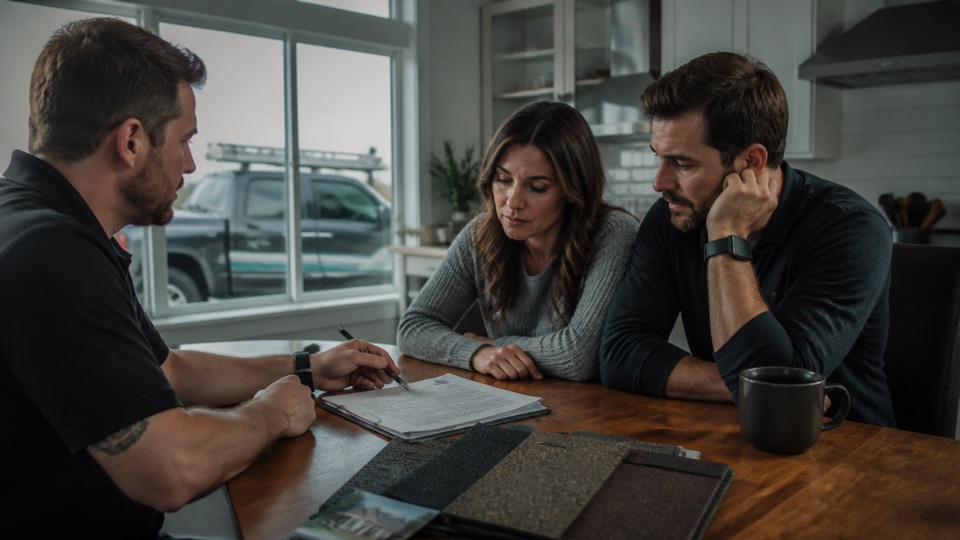
The thousand dollars that walks out of every third driveway
You see it in the contracts before you see it at the table. The same roof, the same materials, the same crew, and one rep sells it at full price while another sells it eight hundred under, then twelve hundred under, then with a free gutter guard thrown in. Ask the second rep and the answer is always the same: "They were going with the other guy, I had to save it."
Sometimes that is true. Most of the time the homeowner said "that is more than I expected" and the rep heard "no." Nobody asked what they expected, what the other bid included, or whether the deductible was the real worry. The rep reached for the only lever they were sure of, and the lever was your margin.
The owner pays for that twice. Once on the job itself, and again when the rep learns that discounting works and does it on the next appointment before the homeowner even pushes. Over a season, the habit costs more than any single bad lead ever will.
Why the discount is a training problem, not a character problem
Reps do not discount because they are lazy or greedy. They discount because silence after a price is uncomfortable and nobody taught them what to say into it. A rep who has never practiced holding the number for five seconds will fill that silence with a concession every time.
Most roofing companies teach the product and the inspection and then send reps to the table with the price as an afterthought. The number gets read off a tablet at the end of a long walkthrough, with no build-up and no reason attached to it. Of course it sounds negotiable. It was presented like an opening offer.
That makes it fixable. Price presentation and objection handling are skills, and skills improve with reps. The question for the owner is whether those reps happen in practice or on live appointments with your margin on the line.
What the price conversation should sound like
Write down your process for presenting the price and make every rep run it the same way. Stack the value before the number: what the inspection found, what the scope covers, the warranty, the crew, the cleanup. Then give one number, stop talking, and let the homeowner respond first.
Then name the three objections that trigger most discounts on your team and write the answer to each. For most roofing companies they are some version of "the other bid was lower," "that is more than we expected," and "we need to think about it." Each answer starts with a question, not a concession. What did the other bid include? What were you expecting, and what was that based on? What part do you want to think through?
Finally, set a discount rule. Reps do not cut price at the table on their own. If a real competitive situation needs a number, it goes through you or a manager with the details. That one rule changes the math, because the discount stops being the easy way out of an uncomfortable moment.
- Stack the value before the number, then give one price and stop
- Answer the three discount triggers with a question first
- No price changes at the table without a manager review
Drilling it before it costs you a roof
The rep who folds on price needs to hear "the other guy was three grand cheaper" fifty times before a homeowner says it once. In Revenue OS that happens in AI role play. Every weekday each rep runs a practice against a simulated homeowner who pushes back on price, and gets scored in about 60 seconds on five criteria at 20 points each: script adherence, objection handling, close attempt, energy and tone, follow-up setup. A 70 clears. Three scores under 60 in a row open a manager enforcement action.
Real appointments get the same treatment. With the homeowner's consent, the appointment is recorded from the rep's phone, transcribed, and scored on six skills: value stacking, objection handling, close timing, price presentation, follow-up setup, and talk-to-listen ratio, plus your own kitchen-table process at 60% weight. The moment the price moved is timestamped. You can hear whether the homeowner actually pushed or the rep dropped it unprompted.
Any appointment under 80 becomes a redo due 6pm the next business day, so the rep who caved on price practices that exact moment again while it is fresh. The Sales Academy lessons cover value stacking and price presentation for the reps who need the foundation, not just the drill.
Holding the line as an owner
The discount habit comes back the moment the owner stops looking. That is why the Compliance Score matters: one number per rep from 0 to 100, recalculated nightly, built from training completion 30%, daily tasks 25%, role play quality 25%, and manager enforcement 20%. The rep who stopped practicing price shows up before their contracts start slipping.
73% of sales managers spend under 30 minutes a week coaching a rep (ATD 2025, Gong 2025). You do not need more time than that. You need the right forty seconds: the timestamped moment where a rep gave away a thousand dollars, played back in the Monday meeting next to the rep who held the number on the same objection.
Recording is initiated by your company, which owns consent including in all-party consent states. Audio is deleted 90 days after upload and no voiceprints are made. Set that up, write the price process down, and run it for a month. The reps who were selling on discount will either learn to hold the number or show up clearly on the list, and every roof you sell at full price goes straight to the margin you were already earning.
The short version
- Roofing reps discount because dropping the price is the only response to hesitation they have practiced.
- Stack the value before the number, give one price, and answer the three discount triggers with a question first.
- Make price changes at the table go through a manager so the discount stops being the easy way out.
- Drill price objections in daily role play and score real appointments so you can hear exactly where the price moved.
Questions owners ask
Why do roofing sales reps give discounts so quickly?⌄
Because the silence after a price is uncomfortable and most reps have never practiced what to say into it. When a homeowner hesitates, the rep reaches for the one move they are sure of, which is cutting the number. It is a training gap, not a character flaw, and it closes with a set price process and repeated practice on the objections that trigger it.
Should roofing reps be allowed to negotiate price at the kitchen table?⌄
Most owners do better with a rule that reps do not change price on their own. A real competitive situation goes to a manager with the details of the other bid. That keeps legitimate deals alive while removing the discount as the reflex answer to every hesitation.
How can an owner tell if a rep is discounting before the homeowner even pushes?⌄
Score the real appointments. With consent, each appointment is recorded, transcribed, and scored on skills including price presentation and objection handling, with the moment the price moved timestamped. You can hear whether the homeowner asked for a lower number or the rep offered one unprompted.
See how the system runs in Roofing & Exteriors.
Revenue OS for Roofing & ExteriorsYour best month ever, and the plan to beat it.
Break Your Revenue Record