
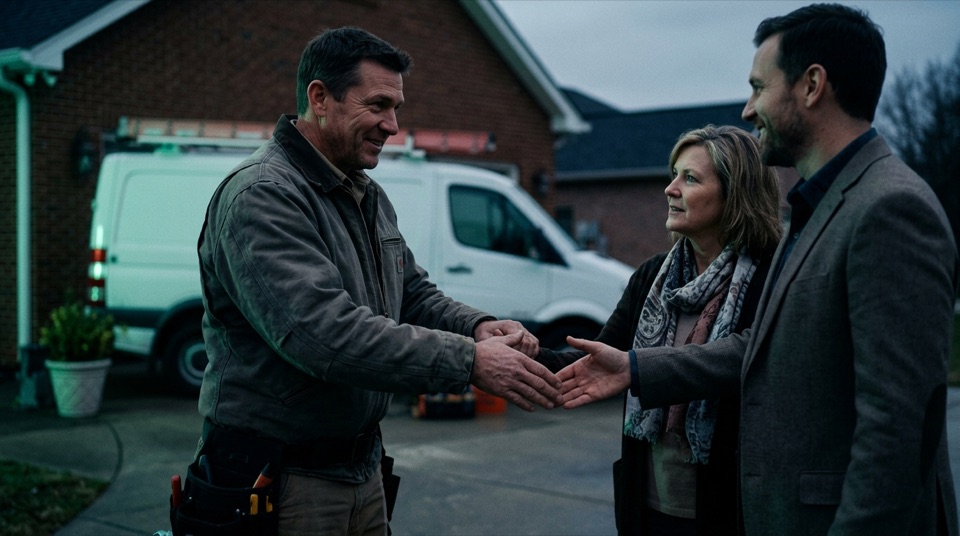
The sale is half decided before the advisor rings the bell
Think about what the homeowner has heard by the time your comfort advisor arrives. If the tech said "you need a new system, someone will call you," the homeowner heard a sales pitch coming and started calling other companies. If the tech said nothing and quoted the repair, the advisor is not coming at all. If the tech explained what failed, why a repair on that system is money thrown at a dying unit, and that the advisor will walk the house and lay out real options, the homeowner is ready to listen.
Same lead. Same equipment. Three completely different appointments for the advisor, and the difference was thirty seconds of the tech's words. Most owners never hear those thirty seconds. They see the advisor's close rate and blame the advisor.
Why techs avoid the handoff
Ask a tech to hand off a replacement lead and here is what he hears: turn into a salesperson. He has met the pushy tech from the competitor who condemns every system. He does not want to be that guy. He also does not want to stand in a hot utility room having a conversation he has never rehearsed, so he takes the path that ends fastest. Quote the repair, get the signature, get back in the truck.
This is not laziness and it is not a bad attitude. It is a conversation he has never practiced, in a moment he dreads. Give him the words, let him say them out loud twenty times where nobody is watching, and the avoidance mostly disappears. Techs who know exactly what to say do not mind saying it.
The second reason is that nothing happens when the handoff is skipped. Nobody knows. If the visit is not recorded and the handoff is not a step in a scored process, the tech who skips it looks identical to the tech who does it. People do what is measured.
The words for the moment of diagnosis
Do not train techs to close. Train them to explain and introduce. The structure is short. First, what was found, in plain words: the compressor has failed, and on a system this age the rest is not far behind. Second, the honest choice: a repair is possible, here is roughly what it buys you, and here is why it is a poor bet. Third, the introduction: a comfort advisor named so-and-so can be here this afternoon, will look at the ductwork and how the house is used, and will lay out options with financing. Fourth, the ask: does this afternoon or this evening work.
Write your version down. Keep it under a minute. Then have every tech practice it. In Revenue OS a tech can run that exact conversation against an AI homeowner by text or live voice, choose from 5 personas plus custom ones built on your market at 3 difficulty levels, and get a score in about 60 seconds with a coach's note. The skeptical homeowner, the one who says "just fix it," the one who wants to call a brother-in-law. Twenty reps of each and the words are his.
- What failed, in homeowner language
- Why repair is a poor bet on this system
- Who the advisor is and what they will do
- Ask for a time today
Speed and information on the advisor side
The handoff has two halves. The tech's words are one. The advisor's arrival is the other. A homeowner with a dead system in July is shopping by dinner. An advisor who arrives two days later is competing with two bids. Make same-day the standard whenever the schedule allows, and make the tech's job include booking the time before he leaves, not passing along a phone number.
The advisor also needs to arrive knowing what the tech said. What failed, what the homeowner reacted to, whether a spouse was mentioned, what the tech quoted for the repair. An advisor who repeats the diagnosis from scratch signals that the company does not talk to itself. An advisor who opens with what the tech found and what the homeowner said about the upstairs bedrooms signals the opposite.
Close the loop back to the tech. He should learn whether the job sold. Techs who see their handoffs turn into installs keep handing off. Techs who hand off into a void stop.
How to see who is handing off and who is not
Put the handoff in your written sales process as a named step. Record service visits with the homeowner's consent, from the tech's phone. Score every visit against your process. When the handoff is a scored step, the tech who skipped it gets a low mark on that step with a timestamp, and the tech who ran it well has a moment you can play for the rest of the team.
Revenue OS scores each visit on six skills plus your own process at 60% weight, marks the best and worst moment, and puts a visit under 80 into a redo due 6pm the next business day against an AI homeowner seeded with the real homeowner's words. The tech who fumbled the handoff on Tuesday practices that exact handoff Wednesday morning. Managers get a coaching queue by urgency, so the conversation is five minutes about one moment instead of an hour of guessing.
73% of sales managers spend under 30 minutes a week coaching a rep (ATD 2025, Gong 2025). That half hour has to land on the right moment. A scored handoff step tells you which moment.
Start this week
Monday, write the diagnosis script with your best tech. Tuesday, every tech runs it three times against a simulated homeowner and shares scores. Wednesday, same-day advisor arrival becomes the rule and techs book the time before leaving. Thursday, record and score the first visits with the handoff as a step. Friday, publish which techs made the handoff on qualifying visits. Then repeat every week. The replacement revenue was always there. The handoff is how you collect it and break your revenue record.
The short version
- The advisor's close rate is set largely by thirty seconds of the tech's words at diagnosis.
- Techs avoid the handoff because they never practiced it and nothing happens when they skip it; fix both.
- Script the diagnosis moment as explain and introduce, not close, and drill it against a simulated homeowner.
- Make same-day arrival the standard, brief the advisor, and close the loop back to the tech.
- Score the handoff as a named step on recorded visits so skipping it shows up per tech.
Questions owners ask
Should HVAC technicians be trained to sell replacements themselves?⌄
No. Train them to diagnose out loud, present the honest choice between repair and replacement, and introduce the comfort advisor by name and by what the advisor will do. That is explaining, not closing. Techs accept it because it is honest, and homeowners respond because it sounds like a professional describing the situation rather than a pitch.
How fast should a comfort advisor arrive after a tech finds a failed system?⌄
Same day whenever the schedule allows. A homeowner with a dead system in summer is calling other companies within hours. Have the tech book the time before leaving instead of passing along a phone number, and make sure the advisor knows what the tech said and what the homeowner reacted to before knocking on the door.
How can an owner tell which techs are actually making the handoff?⌄
Write the handoff into your sales process as a step, record service visits with the homeowner's consent, and score every visit against that process. A skipped handoff becomes a low score on that step, timestamped, for that tech. Track it per person and the techs who hand off and the techs who quote the repair and leave separate within a week.
See how the system runs in HVAC.
Revenue OS for HVACYour best month ever, and the plan to beat it.
Break Your Revenue Record