
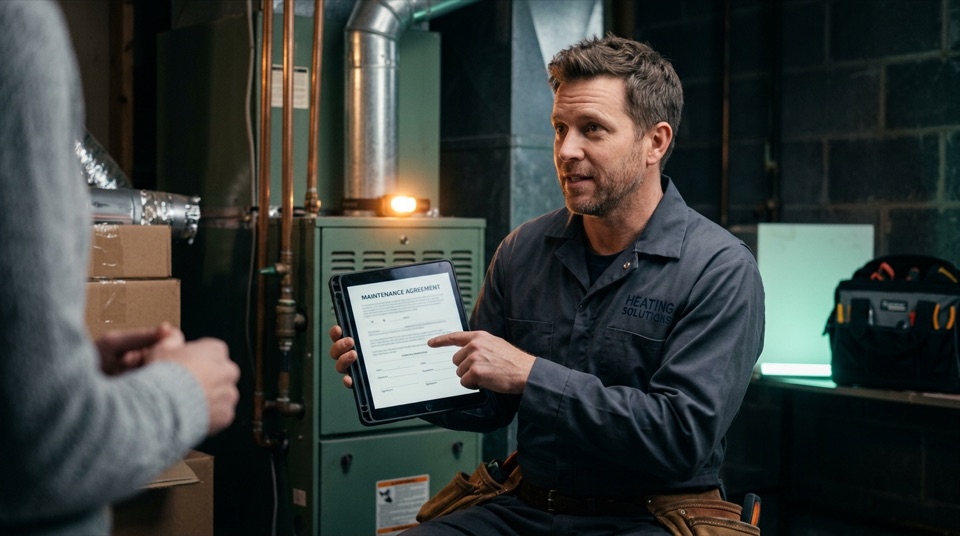
The easiest sale in your company is not happening
Look at your maintenance base. It is roughly flat. Renewals trickle in from the office sending letters. Upgrades to the better plan almost never happen. Meanwhile your techs are inside those homes twice a year, and in most of those visits the agreement is never mentioned. The tech finishes the tune-up, hands over the paperwork, and leaves. The customer who already said yes once is never asked to say it again.
Every other sale in HVAC requires a lead, a drive and a stranger's trust. This one requires none of that. The customer called you. The tech is already there. And it still leaks, because nobody wrote down when and how the conversation happens, so it does not happen.
Why techs skip it
Three reasons. First, they think of it as selling and they did not sign up to sell. Second, they have no words for it, so it comes out awkward and gets declined, and after a few declines they stop. Third, nothing happens when they skip it. The visit looks complete on the ticket. Nobody knows the agreement was never mentioned.
The first two are fixed by reframing and practice. The third is fixed by making the agreement a step in the visit that gets scored. Fewer than half of companies reinforce training after paying for it, and this is exactly the kind of behavior that needs reinforcing, because it is easy to skip and invisible when skipped.
The agreement as a step, not a pitch
The agreement should come up at the same moment as the findings, not after the tech is packing up. "Here is what the system looked like today. Two things to watch. Your agreement is what keeps this covered and gets you ahead of the season, and it renews next month. Do you want to keep it going, or move to the plan that covers the water heater too?" That is it. The findings, the agreement as the reason those findings get handled, and a two-option question.
Notice what is not in there. No urgency. No discount. No speech about the value of maintenance. The agreement is presented as the obvious next step by the person who just put his hands on the equipment. Homeowners say yes to that far more often than to a letter from the office.
Write your version down. The exact moment in the visit, the exact words, the two options. Give it to every tech and have them practice it before they run it in a home.
- Findings first, in plain language
- Agreement as the reason the findings get handled
- Two options: renew as is, or move up a plan
- Handle the objection once, ask again, then stop
The upgrade conversation
The upsell to a better plan follows the same shape with one addition: a reason tied to the house. "Your system is twelve years old and you told me the water heater has been noisy. The upper plan covers both and adds priority scheduling in the summer." The reason comes from something the tech saw or the homeowner said. Without that reason it is an upsell. With it, it is advice.
The objection is always the same. "I will think about it." Or "we are fine with the basic one." Give the tech one honest answer and the ask again. Then stop. A tech who has run that exact exchange against an AI homeowner twenty times will handle it calmly. In Revenue OS, techs practice by text or live voice against 5 personas plus custom ones at 3 difficulty levels, scored in about 60 seconds on five criteria at 20 points each with a coach's note. 70 clears. Three under 60 in a row open a manager enforcement action, so the tech who avoids the practice cannot avoid it for long.
How to see who is doing it
Put the agreement conversation in your scored visit process as a named step. Record maintenance visits with the homeowner's consent, from the tech's phone. Score them against your process. A tech who never mentions the agreement gets a low mark on that step, timestamped, every time. A tech who runs it well produces a clip you can play at the Monday meeting.
Revenue OS scores each recorded visit on six skills plus your own process at 60% weight, and a visit under 80 becomes a redo due 6pm the next business day against an AI homeowner seeded with the real homeowner's words. The tech who skipped the agreement on Tuesday runs the agreement conversation on Wednesday morning. Managers see a coaching queue by urgency, so the conversation with the tech is about one moment, not about attitude.
Roll it into one nightly number per tech. Training completion, daily tasks, role play quality and manager enforcement, 0 to 100, ranked. The techs who present the agreement rise. The techs who skip it show at the bottom and you know why before you ask.
The next thirty days
Week one, write the agreement step with your best tech and make every tech practice it. Week two, record and score maintenance visits with the agreement as a step. Week three, publish per-tech results for how often the agreement was presented on qualifying visits. Week four, add the upgrade conversation and its objection to the daily practice. By the end of the month you will know which techs present the agreement and which do not, and the base will have started to move for the first time in years. That is the quietest way in HVAC to break your revenue record.
The short version
- The maintenance renewal is the easiest sale in HVAC and it leaks because nobody wrote down when the tech says it.
- Present the agreement with the findings as the reason they get handled, with two options, not as a pitch at the end.
- The upgrade needs a reason from the house or the homeowner's own words; without it, it is an upsell.
- Score the agreement as a named step on recorded visits so skipping it is visible per tech.
Questions owners ask
When during a maintenance visit should a tech bring up the agreement renewal?⌄
At the same moment as the findings, not while packing up. The tech explains what the system looked like, names the agreement as what keeps those findings covered, and asks a two-option question: renew as is or move up a plan. Presented there, by the person who just inspected the equipment, it reads as the next step rather than a pitch.
How do you get techs who hate selling to upsell maintenance plans?⌄
Stop calling it selling and give them words. The upgrade is advice tied to something they saw: an aging system, a noisy water heater, a family that suffers in the summer. Let them practice the exact exchange against a simulated homeowner until it is calm, and make it a scored step in the visit so it happens whether or not they feel like it that day.
How can an owner track whether techs are presenting maintenance agreements?⌄
Record maintenance visits with the homeowner's consent, write the agreement conversation into your process as a step, and score every visit against it. The step gets a mark per visit, per tech, with a timestamp. Roll those into one nightly number per tech and the pattern shows on one screen without riding along or asking anyone.
See how the system runs in HVAC.
Revenue OS for HVACYour best month ever, and the plan to beat it.
Break Your Revenue Record