
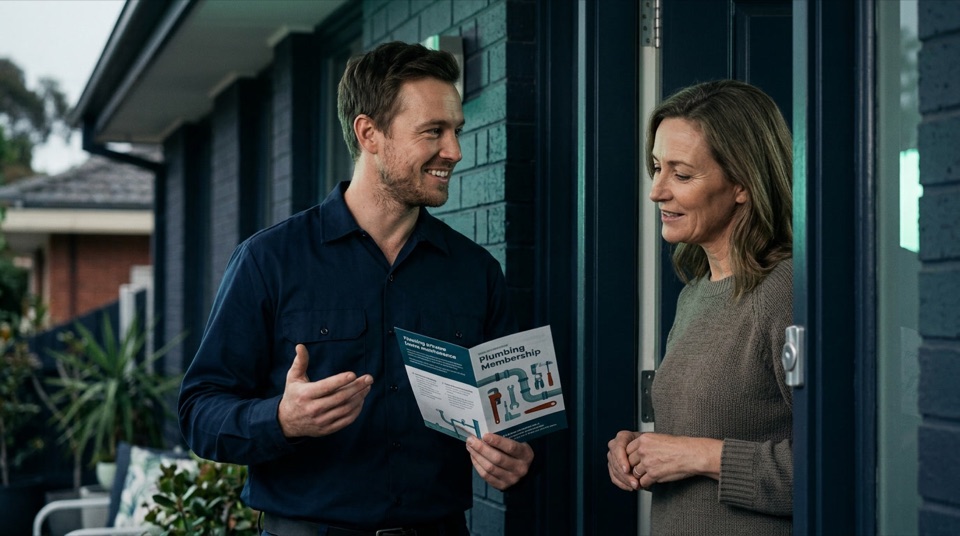
The membership pitch at the door
Watch how the membership actually gets offered in your company. The tech finishes the repair, writes the invoice, and while the homeowner is reaching for a card he says, "Oh, and we have a maintenance plan if you are interested." The homeowner, who has just paid for a repair they did not want, says "not right now." The tech says "no problem," checks the box that says it was offered, and leaves.
Everyone did what they were told. The membership was offered on every call. The attach rate is still low, and the owner concludes homeowners do not want it. They do want it. Nobody has heard a reason to buy it, because it was presented as a program, at the worst possible moment, by a tech who was clearly relieved when they said no.
Why techs hate it and homeowners refuse it
Techs resist the membership for the same reason they resist every part of selling: it feels like asking a stranger for money for something they did not request. That instinct is right about the door pitch and wrong about the product. A membership presented properly is the most honest thing a tech says all day. It is the tech telling the homeowner how not to need him for an emergency.
Homeowners refuse it because it arrives with no context. A plan for a monthly fee sounds like a subscription they will forget about. The same plan, presented right after the tech explained that the heater is eleven years old and the pressure regulator is reading high, sounds like a way to catch the next problem before it floods the basement. Context is the whole difference, and context only exists in the middle of the call.
Move it from the door to the middle of the call
Put the membership in the process right after the diagnosis and the options, before the invoice. The tech has just explained what he found. The homeowner is thinking about the house, not the bill. That is the moment. "Here is what caused today's problem. Here is how a yearly inspection catches this kind of thing before it fails. That is what the membership is, and it runs this much a month." One breath, tied to the finding, then quiet.
The words should describe the homeowner's problem, not the company's program. Not "we offer a plan with priority scheduling and a discount." Instead, "you have a fourteen-year-old heater and older pipes, so having someone look at the whole system once a year is how you avoid the Sunday call." Techs will say the second version because it is true and it is about the customer. They will not say the first version with any conviction, and the homeowner hears the missing conviction.
- Present it right after the diagnosis, before the invoice
- Tie it to what was found in this house today
- Describe the homeowner's problem, not the company's program
- State the monthly cost plainly and stop
Train the words and the "I will think about it"
A tech who has said the membership sentence once at a Saturday meeting will not say it on Monday in a stranger's kitchen. He has to have said it thirty times to a simulated homeowner first, including the follow-up when the homeowner says "I will think about it" or "I do not really use plans like that." Those two objections cover most membership refusals, and each has a short, honest response. "Fair enough. The main thing it does for you is the yearly inspection on that heater. Would it help if I put the first one on the calendar now and you can decide then?"
In Revenue OS, techs practice this against an AI customer by text or live voice, with 5 personas plus custom personas and 3 difficulty levels, scored in about 60 seconds on script adherence, objection handling, close attempt, energy and tone, and follow-up setup at 20 points each, with a coach's note. 70 clears. The membership is short enough to drill in ten minutes before the first call, which is exactly the kind of practice dispatch cannot object to.
See who offers it and where
The checkbox on the invoice tells you the membership was mentioned. It does not tell you when, how, or whether the tech waited for an answer. Recording the visit from the tech's phone with the homeowner's consent does. When the membership is a step in your scored process, the score shows whether it was presented after the diagnosis or muttered at the door, and the moment is timestamped. Your process carries 60% of the score, so a skipped or misplaced membership shows up as a number that night.
A visit that scores under 80 becomes a redo due 6pm the next business day against an AI homeowner seeded with the real customer's words. The tech who let "not right now" end it practices that exact exchange the next morning. Over a month, attach rate stops being a mystery. It is two techs who present it in the middle, three who present it at the door, and one who does not present it at all, each with a different five-minute conversation waiting.
The short version
- The membership sounds pushy at the door and sounds like advice in the middle of the call, right after the diagnosis.
- Describe the homeowner's problem, not the company's program, and state the monthly cost plainly.
- Drill the sentence and the two common refusals daily so the tech says it with conviction instead of relief when the answer is no.
- Put the membership in your scored process so you can see who presents it, when, and how, without riding along.
Questions owners ask
When in the service call should a plumber offer the maintenance membership?⌄
Right after the diagnosis and the repair options, before the invoice. The homeowner is thinking about the house at that moment, not the bill, and the tech can tie the membership to what he just found. Offered at the door while packing up, it lands as an afterthought and most homeowners decline before they have heard a reason.
What should a tech say when the homeowner says "I will think about it" to the membership?⌄
Agree, restate the one thing it does for this house, and offer a small next step. "Fair enough. The main value for you is the yearly inspection on that heater. Would it help if I put the first one on the calendar and you decide then?" Short and honest. It has to be rehearsed against a simulated homeowner so it comes out calm, not defensive.
How do I know if my techs are actually offering the membership?⌄
The invoice checkbox only proves it was mentioned. Record visits with consent and score them against a process that includes the membership as a step, so the score shows whether it was presented in the middle of the call with a reason or muttered at the door. Compare techs over a month and the attach rate stops being a mystery.
See how the system runs in Plumbing.
Revenue OS for PlumbingYour best month ever, and the plan to beat it.
Break Your Revenue Record