
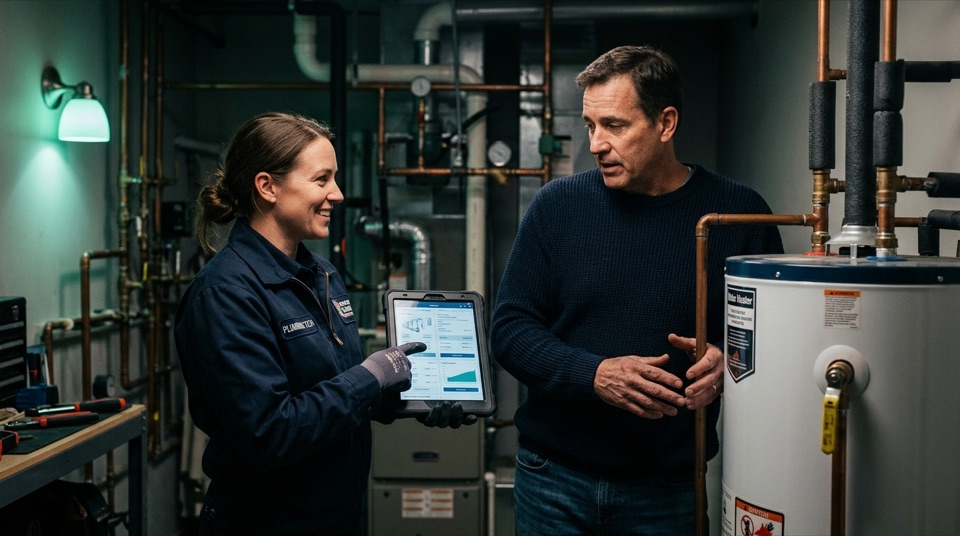
Your techs fix the leak and leave the money on the counter
Look at yesterday's tickets. A tech went to a house for a leaking shutoff valve. He replaced the valve, wrote it up, and left. The water heater in the same utility room was fourteen years old with rust at the base. The homeowner had no maintenance agreement. The tech never mentioned either one. The ticket was $240 and the truck cost you more than that to get there.
This happens on most service calls in most plumbing companies. The tech does exactly what the homeowner asked and nothing else. He would rather be back in the truck than standing in a kitchen talking about options. So the repair-versus-replace conversation never happens. The water heater conversation never happens. The membership never gets offered. The homeowner pays the minimum and calls a different company for the big job next year.
The math is brutal because the lead and the drive are already paid for by the time he rings the doorbell. Everything above the minimum repair is close to pure margin.
Techs do not want to look like salespeople, and they are right
Ask a plumber to sell and he hears: lie to old ladies about their pipes. He has met the pushy tech from the competitor who condemns every water heater. He does not want to be that guy, and you should not want him to be either. The homeowner can smell it, and one bad review about upselling costs more than the upsell earned.
So do not train techs to sell. Train them to diagnose out loud and present options honestly. The words are different and the tech can hear the difference. A salesperson says you need a new water heater. A professional says this heater is fourteen years old, here is what the rust means, here is what a repair costs today and here is what a replacement costs, and here is what happens if it fails on a Sunday. Then he stops talking and lets the homeowner choose.
This framing does two things. It gives the tech permission, because he is informing, not pushing. And it works better, because homeowners buy from the person who explained the situation clearly and gave them a real choice.
Repair versus replace: the conversation that decides the ticket
Almost every plumbing call has a fork in it. Fix the valve or replace the whole assembly. Snake the drain or scope the line. Patch the heater or replace it. Most techs resolve that fork in their own head, pick the cheap option because it is faster, and never tell the homeowner there was a choice. The homeowner never gets to decide, and the company never gets the larger ticket.
Train the fork as a process. Diagnose fully before quoting anything. Explain what was found in words a homeowner uses, not trade terms. Present at least two options with prices side by side. Recommend one and say why, tied to what the homeowner said about the house and how long they plan to be there. Ask which one they would like to do today. If they hesitate, handle the objection and ask again. Write your version of these steps down. That document becomes the standard for lessons, practice, and scoring.
The objections are predictable, which means they are trainable. "Just fix it for now." "I want to get another price." "Let me talk to my husband." "That is more than I expected." Each one needs a short, honest response the tech has said out loud dozens of times before a homeowner says it. In Revenue OS, techs practice against an AI customer by text or live voice, with 5 personas plus custom personas built on your market at 3 difficulty levels, and get a score in about 60 seconds with a coach's note.
- Diagnose fully before quoting
- Explain the finding in homeowner language
- Present two options with prices side by side
- Recommend one and say why
- Ask for a decision today, and ask again after the objection
The water heater and the maintenance agreement
Two conversations should happen on nearly every call, and they are the two most skipped. The first is the water heater. It is in almost every house, it has a known lifespan, and the tech is standing next to it. A 30-second check and a plain sentence about age and condition is not an upsell. It is what a homeowner would want a professional to notice. Train the check into the call as a step, not an option, and train the sentence that follows it.
The second is the maintenance agreement. Most techs mention it at the end, if at all, as an afterthought while packing up. The homeowner hears a pitch and says no. Trained properly, the agreement is presented as the next step after the repair: this is how the system stays out of trouble, this is what it covers, this is what it costs per month. Presented in the middle of the call, tied to what the tech just found, it lands. Presented at the door, it does not.
Both belong in your scored process. When real calls are recorded from the tech's phone with the homeowner's consent and scored against your steps, you see which techs checked the heater and offered the agreement and which skipped both. That becomes a redo the next day on the exact step that was missed.
Dispatch pressure and the 20-minute problem
Every plumbing owner knows the objection before the trainer finishes the sentence: there is no time. The board is full, the dispatcher is pushing, and a tech who spends fifteen extra minutes presenting options is a tech who runs one fewer call. That is true and it is also the reason the average ticket is stuck. A company that treats the call count as the only number will get a lot of $240 calls.
Fix it with two changes. First, give dispatch a second number to protect: not just calls per day, but ticket per call. When the dispatcher knows the tech is spending ten minutes presenting a replacement, the schedule can absorb it. Second, make the training itself short enough that dispatch cannot object. One 20-minute lesson before the first call, ten minutes of practice on yesterday's objection, done. A tech who cannot find 30 minutes before the first appointment is not out of time. He is out of habit.
Training that stops at the Saturday meeting fails on schedule. 84% of what reps learn in training is gone within 90 days (Sales Performance International). Fewer than half of companies reinforce training after paying for it.
A 90-day plan for a plumbing company's sales side
Month one: objections and the fork. One 20-minute lesson per weekday on a single objection or a single step of the repair-versus-replace conversation, followed by role play on that exact moment, scored. "Just fix it for now." "I want another price." "That is more than I expected." Real calls are recorded with consent and scored from day one against your process, so you can see who is presenting options and who is still fixing the leak and leaving. The Sales Academy in Revenue OS runs this as a 90-day plan with a workbook and quiz after every lesson, so completion means the tech actually did it.
Month two: follow-up. The homeowner who chose the repair today is a replacement in six months if someone follows up. 80% of sales are made between the 5th and 12th follow-up attempt, and 48% of salespeople never follow up at all (from the Million Dollar Follow-Up course). Techs learn a simple follow-up sequence and the words for each touch, and the office learns to see whether the touches went out.
Month three: ticket and pricing. Presenting the replacement price without flinching. Presenting the maintenance agreement as part of the recommendation. Handling "that is too much" without dropping the price. Across all 90 days, one nightly score per tech shows who completed the lesson, practiced, held the process on real calls, and finished redos. Publish it. By day 90 you have techs who diagnose out loud, present honest options, and ask for the decision, and you can see it happening without riding along in the truck.
The short version
- The service call is a sale with steps, and most techs skip every step except the repair.
- Do not train techs to sell; train them to diagnose out loud, present honest options, recommend one, and ask.
- The water heater check and the maintenance agreement belong in the middle of the call as scored steps, not at the door.
- Protect ticket per call alongside calls per day, keep daily training to 30 minutes, and publish a nightly score.
Questions owners ask
How do I get plumbing technicians to sell without being pushy?⌄
Change the standard from selling to informing. Train techs to diagnose fully, explain the finding in plain words, present two options with prices, recommend one with a reason, and ask for a decision. Homeowners buy from the tech who gave them a real choice. Practice the objections against a simulated homeowner so the words are honest and ready.
How do I get techs to offer the maintenance agreement on every call?⌄
Move it from the door to the middle of the call. Present it right after the diagnosis as the next step, tied to what the tech just found, with the monthly cost. Put it in your scored process so a skipped agreement shows up on the call score instead of disappearing, and drill the "I will think about it" response in role play.
Is there time to train plumbers when the board is full?⌄
Yes, if the training is 30 minutes a day and dispatch protects ticket per call, not just calls per day. A 20-minute lesson before the first call and ten minutes of practice on yesterday's objection fits before the first appointment. Real calls are scored automatically, so nobody has to listen to recordings to see who is presenting options.
See how the system runs in Plumbing.
Revenue OS for PlumbingYour best month ever, and the plan to beat it.
Break Your Revenue Record