
The system is dead, the homeowner is sweating, and your advisor still lost the job
It is the best lead in the trade. A technician finds a failed compressor on a fifteen-year-old system in July. The homeowner needs a replacement and knows it. Your comfort advisor shows up the same afternoon. And the homeowner says they want to think about it, or get another quote, or ask a relative who used to do HVAC. The advisor leaves with nothing. Three days later a competitor installs the system.
You have seen this enough times to know it is not the lead. It is the conversation. Your advisor presented one option, quoted a number, and waited. Or presented three options and could not explain why the middle one was right for this house. Or never mentioned financing until the homeowner flinched. Each of those is a training gap, and each one costs you a five-figure ticket during the weeks when tickets are everywhere.
Most HVAC owners know this and still train the way the trade always has: ride-alongs for a few weeks, a manufacturer's product class, and then the advisor is on their own. Fewer than half of companies reinforce training after paying for it. By the time the season peaks, the advisor is selling on instinct, and instinct is uneven.
The in-home replacement sale as a process
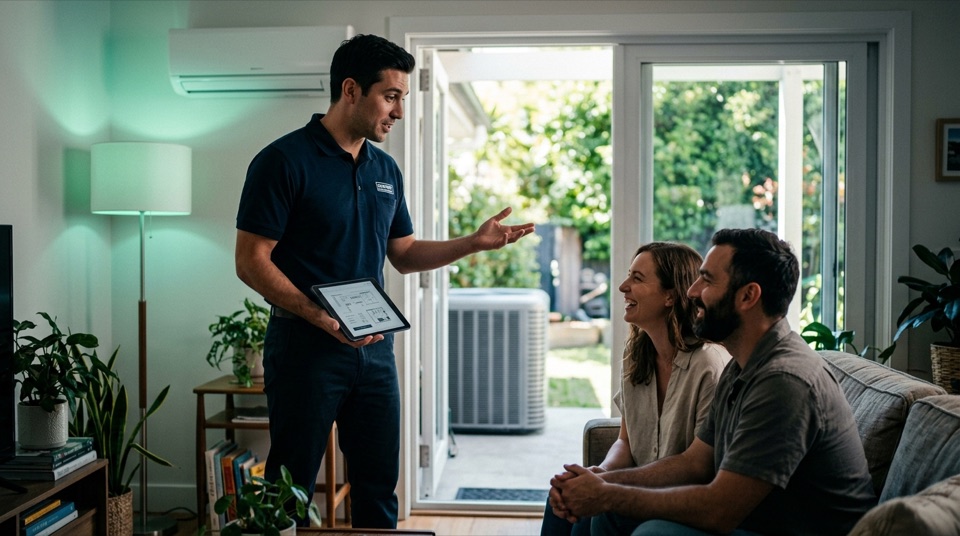
A replacement sale has a shape. The advisor arrives knowing what the technician found. They walk the house, look at ductwork, ask how the family uses the space, and find out what the homeowner has hated about the old system. They explain what they found in plain language. They present options, usually three, and recommend one with a reason tied to what the homeowner said. They present the price with financing already on the table. They ask for the decision. They set the install date or book the follow-up before leaving.
Every one of those steps is teachable and checkable. An advisor who skips the walk-through cannot tie the recommendation to the home. An advisor who presents price without financing invites the objection. An advisor who does not ask for the decision does not get one. Write your version of the process down, step by step, in the words you want used. That document is the standard for training, practice, and scoring.
When real visits are recorded with consent and scored against that process, you stop guessing. Revenue OS scores in-home conversations from the advisor's phone against six selling skills and against your own process at 60% weight, then marks the best and worst moment. You see that the advisor presented the price at minute 34 and never asked for the sale. That is the coaching conversation, and it takes five minutes.
The technician-to-advisor handoff decides half the sale
Most replacement leads start with a technician. The tech finds the failure, tells the homeowner, and either sets up the advisor visit or does not. How the tech frames that conversation decides whether the advisor walks into a warm lead or a suspicious one. A tech who says you need a new system, someone will call you creates a homeowner who is already looking for a second opinion. A tech who explains what failed, why repair is a poor bet, and what the advisor will do for them creates a homeowner who is ready to listen.
Train the tech side of the handoff as seriously as the advisor side. Techs are not salespeople and should not be trained as closers. But they can learn a short, honest script for the moment of diagnosis and a clean way to introduce the advisor. Role play helps here. A tech can practice the conversation against an AI homeowner in ten minutes, get a score, and try again. It takes the awkwardness out of a moment most techs dread.
- Tech explains what failed and why repair is a poor bet
- Tech introduces the advisor by name and by what they will do
- Advisor arrives knowing what the tech said
- Tech learns the outcome of the visit
Maintenance agreements on every call
Maintenance agreements are the most under-sold product in HVAC, and the reason is not the customer. It is that advisors and techs treat the agreement as an afterthought, mentioned at the end if there is time. The customer hears it as an upsell and declines. Trained properly, the agreement is part of the recommendation, not an add-on: this is how the new system stays efficient and under warranty, and this is what it costs per month.
Train the words. The agreement should be presented at the same moment as the system options, with a simple reason. Techs on service calls should present it the same way, as the next step after the repair, not a pitch. Practice this against an AI customer who says I will think about it, because that is exactly what customers say, and the rebuttal has to be ready.
Seasonal spikes and why training cannot pause
HVAC sales arrive in two waves, the first heat and the first cold, and both waves tempt owners to suspend training and just run calls. That is backwards. The spike is when a 15% improvement in close rate is worth the most, and it is when untrained habits cost the most. An advisor who caves on price in July gives away more margin in one week than the training would have cost all year.
Keep the daily rhythm short. One 20-minute lesson before the first call. Ten minutes of role play on yesterday's objection. Real visits scored automatically so nobody has to listen to them all. That is 30 minutes and it fits between the morning meeting and the first appointment. During the slow shoulder months, use the time to go deeper: longer practice, new personas, harder difficulty.
Follow-up matters more during the spike, because homeowners are collecting quotes. 80% of sales are made between the 5th and 12th follow-up attempt, and 48% of salespeople never follow up at all (from the Million Dollar Follow-Up course). Every advisor who leaves without a signature needs a scheduled next touch that day, and you need to be able to see whether it went out.
A 90-day plan for HVAC comfort advisors
Month one: objections. One 20-minute lesson per weekday on a specific objection, followed by role play against a homeowner persona at the advisor's difficulty level, scored on script adherence, objection handling, close attempt, energy and tone, and follow-up setup. I want another quote, the price is too high, can we just repair it, let me talk to my spouse. Real visits are recorded with consent and scored from day one so you see who holds the process under a real customer.
Month two: follow-up. The homeowner who did not sign today is the job for next week. Advisors learn a follow-up sequence, the exact words for each touch, and how to re-open a conversation without sounding desperate. Stalled deals get worked deliberately: describe the stuck deal, get three named plays with exact words and the reason each works, run one, log the result. The Deal Helper in Revenue OS does exactly that, and the logged outcomes show which plays work in your market.
Month three: ticket and pricing. Presenting good, better, best with a real recommendation. Indoor air quality and duct work as part of the recommendation, not a bolt-on. Financing presented before the objection, not after. Maintenance agreements on every visit. Across all 90 days, one nightly Compliance Score per advisor shows who completed the lesson, practiced, held the process on real visits, and completed redos. Publish it. In 90 days you have advisors who were trained on the method, drilled daily, tested on real homeowners, and measured every night. That holds through the season and into the next one.
The short version
- The HVAC replacement lead is the best in the trade, and it is lost in the conversation, not the diagnosis.
- Write the in-home sale down as a process, including the tech handoff and the maintenance agreement, and score real visits against it.
- Training cannot pause for the seasonal spike; 30 minutes a day is where the margin is protected.
- Run a 90-day loop: month one objections, month two follow-up, month three ticket and pricing, with a nightly visible score.
Questions owners ask
How do I get HVAC technicians to hand off replacement leads to comfort advisors?⌄
Give techs a short, honest script for the moment of diagnosis: what failed, why repair is a poor bet, and what the advisor will do for the homeowner. Let them practice it against a simulated homeowner until it feels natural. Make sure the advisor knows what the tech said before the visit and the tech learns the outcome. Visibility on both sides raises the quality of the handoff.
How do I train comfort advisors to sell maintenance agreements?⌄
Present the agreement as part of the recommendation, at the same moment as the system options, with a plain reason: it keeps the system efficient and under warranty for a monthly cost. Drill the I will think about it rebuttal in role play, and put the agreement in your scored process so skipping it shows up on the advisor's score instead of disappearing.
Can HVAC sales training run during the busy season?⌄
It has to. The season is when close rate and ticket size matter most. Keep it to 30 minutes a day: a 20-minute lesson before the first call, ten minutes of role play on yesterday's objection, and automatic scoring of real visits so nobody has to listen to every recording. Use the shoulder months for deeper practice.
See how the system runs in HVAC.
Revenue OS for HVACYour best month ever, and the plan to beat it.
Break Your Revenue Record