
Your best closer is on the roof and your reps are losing at the table
You started this company because you can sell a roof. You can walk a homeowner through hail damage, explain what the adjuster will look for, and leave with a signed agreement. Now you have four or six reps doing the same job, and they are not closing the way you do. Storm season comes, the leads pour in, and half of them turn into we want to get a couple more quotes. You know the deal was there. The rep did not have the words.
This is the roofing owner's problem in one sentence: the leads are expensive, the window is short, and the rep at the table is the only thing standing between a paid lead and a signed job. A rep who cannot handle the three-quotes objection during a storm is not a minor problem. Every appointment they fumble is a lead you paid for and a roof someone else installs.
Most roofing owners respond by hiring more reps or buying more leads. Neither fixes the table. Training does, but only if it holds. 84% of what reps learn in training is gone within 90 days (Sales Performance International). If your training happened at a spring kickoff, most of it is gone by the first hailstorm.
The kitchen-table sale is a process, not a pitch
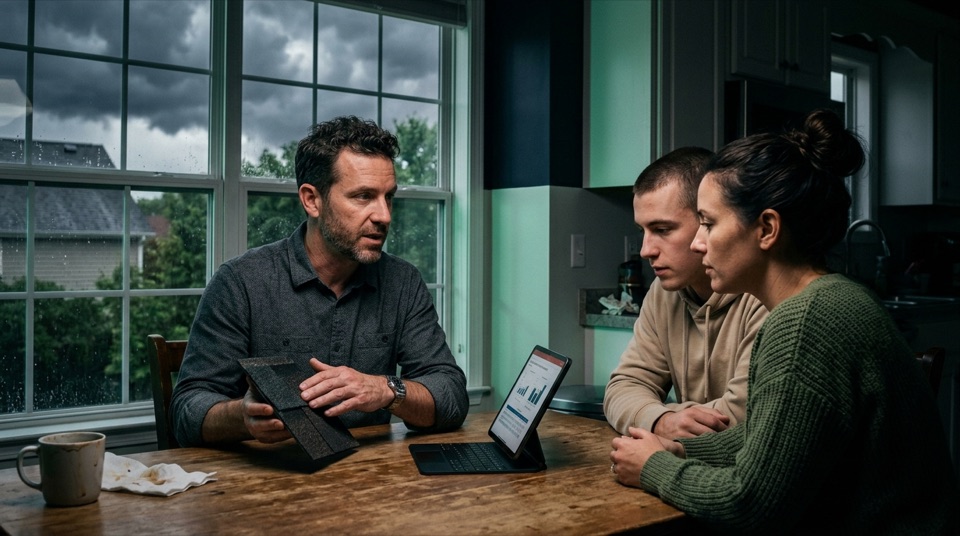
The roofing sale happens at the homeowner's table, often with a spouse, after an inspection the homeowner did not fully understand. The rep has one shot to build enough trust that the homeowner signs before calling three other companies. That is not a personality contest. It is a sequence of steps, and reps who follow the sequence close more than reps who wing it, no matter how likable they are.
The sequence is roughly this. Show the damage with photos from the roof, not a description. Explain what happens next with insurance in plain language, including what the homeowner does and does not have to do. Present the company as the one that will handle the adjuster meeting and the paperwork. Address the objections that always come up. Ask for the agreement. Book the adjuster meeting before leaving.
Write this down as your process and train to it. Every step is teachable. Every step is something a scoring tool can check on a real appointment. When you can see that a rep skipped the insurance explanation and lost the job to a three-quotes objection twenty minutes later, you are no longer guessing what to coach.
Adjusters, insurance, and why your rep has to know more than the homeowner
Homeowners are scared of the insurance process. They have heard stories about denied claims and rate increases. A rep who can explain the process calmly and correctly is worth more than a rep with a lower price. Train your reps to walk through the claim from first call to final payment, in words a homeowner understands, and to say clearly what the company will handle for them.
Then train the adjuster meeting. Your rep should be on the roof with the adjuster, pointing out damage, with photos in hand. That requires product knowledge and a professional manner. It also requires the rep to have set the homeowner's expectation that this meeting is where the company earns its fee. Reps who skip this step lose the job after the adjuster leaves, when the homeowner decides they can handle it themselves.
Role play this. The adjuster conversation, the homeowner's questions about their deductible, the spouse who read something on the internet. In Revenue OS, custom AI personas can be built for your market, so a rep can practice the nervous homeowner or the skeptical spouse at three difficulty levels and get scored in about a minute. Practice the adjuster meeting on a Tuesday morning, not on a homeowner's roof.
The three-quotes objection and how to train for it
Every roofing rep hears it. We want to get a few more quotes. It is the objection that separates closers from order takers, and it is entirely predictable, which means it is entirely trainable. The rep who folds and says sure, call us when you are ready loses most of those jobs. The rep who has the words often does not.
The words depend on your process, but the structure is consistent. Agree that comparing is smart. Ask what they will compare, and point out that in an insurance claim the price is largely set by the carrier, so the comparison is really about who handles the claim and installs the roof. Show what the company does that the others may not. Ask for the agreement again, with a reason to decide today that is true.
Then drill it. Not once at the kickoff. Every day during month one. A rep should hear we want three quotes from an AI customer fifty times before storm season and have said the rebuttal out loud fifty times. When the real homeowner says it, the rep will not be improvising. Score the practice, set a bar, and watch the scores climb before the leads arrive.
- Agree that comparing is smart
- Reframe: the carrier sets the price, the company is the choice
- Show what your company handles that others may not
- Ask again with a true reason to decide today
Storm season changes the math
Storm season compresses everything: leads arrive faster than reps can run them and the temptation is to skip training and just sell. Do not. Storm season is when the lack of training costs the most. Keep the daily rhythm short and non-negotiable. A 20-minute lesson before the first appointment, a ten-minute role play on the objection that came up yesterday, and scored real appointments so you can see who is holding the process under pressure. That is 30 minutes a day. A rep who cannot find 30 minutes during storm season is not running out of time. They are running out of discipline.
Follow-up matters more in a storm too, because homeowners are talking to several companies. 80% of sales are made between the 5th and 12th follow-up attempt, and 48% of salespeople never follow up at all (from the Million Dollar Follow-Up course). A rep who leaves the table without a signed agreement needs a follow-up plan that day, and you need to be able to see whether it happened.
A 90-day plan for a roofing sales crew
Month one: objections. Every day, one 20-minute lesson on a specific objection, followed by role play on that objection against a homeowner persona, scored. Three quotes, the deductible, we want to wait for the adjuster, my brother-in-law knows a guy. By day 30 every rep has said every rebuttal out loud dozens of times. Real appointments are recorded with consent and scored against your kitchen-table process from day one, so you see who holds it.
Month two: follow-up. The homeowner who did not sign is not lost. Reps learn a follow-up sequence, the words for each touch, and how to re-engage after the adjuster meeting. Role play shifts to the second and third conversation. Stalled deals get worked with specific plays: in Revenue OS, the Deal Helper takes a description of a stuck deal and returns three named follow-up plays with exact words and the reason each one works.
Month three: ticket and pricing. Presenting upgrades, presenting the price with confidence when the claim does not cover everything, handling the homeowner who wants to pocket part of the settlement. This is where average ticket moves. Throughout all 90 days, a nightly Compliance Score shows who completed the lesson, practiced, and held the process on real calls. Publish it. By day 90 you have a crew that was trained, drilled, tested on real homeowners, and measured every night. That is training that survives the season.
The short version
- Roofing leads are expensive and the window is short, so the rep at the kitchen table is where the money is won or lost.
- Write the kitchen-table sale down as a process, train to it, and score real appointments against it.
- Drill the three-quotes objection and the insurance explanation daily before storm season, not once at kickoff.
- Run a 90-day loop: month one objections, month two follow-up, month three ticket and pricing, with a nightly score.
Questions owners ask
How do I train roofing reps to handle the three-quotes objection?⌄
Give them a structure and drill it daily. Agree that comparing is smart, point out that on an insurance claim the carrier largely sets the price so the real choice is who handles the claim, show what your company does that others may not, and ask again with a true reason to decide today. Reps should practice it against a simulated homeowner dozens of times before storm season.
How long should it take to train a new roofing sales rep?⌄
Plan on 90 days to build a rep who closes consistently at the table, with month one on objections, month two on follow-up, and month three on ticket and pricing. A rep can run appointments earlier than that, but expect them to lose winnable jobs until the objection rebuttals are automatic, which takes daily practice, not a single kickoff.
Should roofing reps record their in-home appointments?⌄
Yes, with the homeowner's consent stated at the start and a written policy that follows your state's rules, including all-party consent where it applies. Recording from the rep's phone and scoring the appointment against your process lets you see exactly where a job was lost and turn that moment into practice the next day.
See how the system runs in Roofing & Exteriors.
Revenue OS for Roofing & ExteriorsYour best month ever, and the plan to beat it.
Break Your Revenue Record