
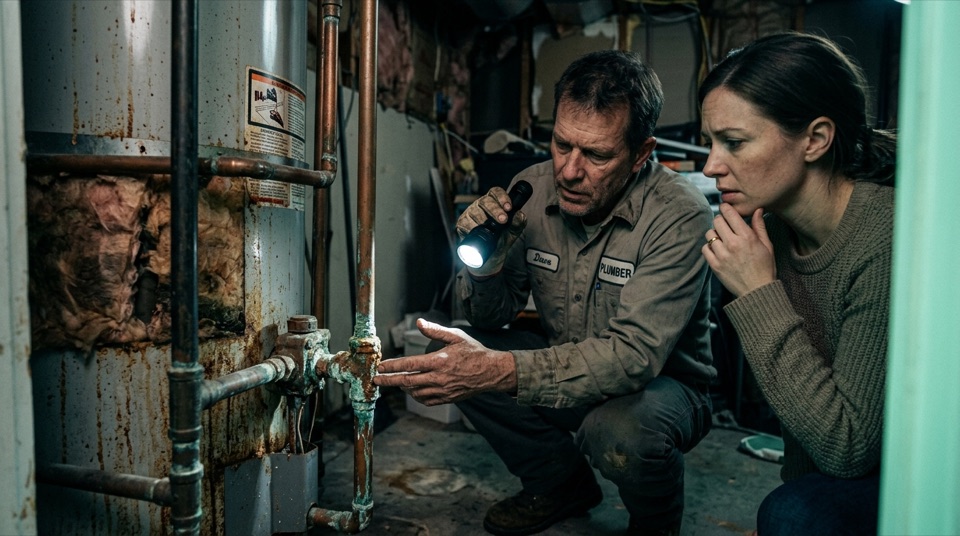
The two biggest tickets in the house are the two most skipped
Pull twenty tickets from last week. On how many did the tech note the age and condition of the water heater? On how many with galvanized or polybutylene supply did the tech mention the repipe? For most companies the honest answer is a handful, and the ones who did it are the same two techs every time.
This is not a knowledge gap. Every tech in your company can look at a heater and tell you it is fourteen years old with rust at the base. Every tech can spot galvanized pipe from across the basement. What they cannot do is turn that observation into a sentence to the homeowner, take the objection that follows, and present a five-figure price without their voice changing. So they keep the observation to themselves and fix the faucet.
The water heater check is a step, not a favor
Put the check in the process. Every call, the tech looks at the water heater, notes age, condition, and any signs of failure, and tells the homeowner what he saw. Thirty seconds. This is not an upsell and it should never be framed as one. It is what a homeowner would want a professional to notice, the same way a mechanic mentions the brake pads.
Then train the sentence that follows. "Your heater is fourteen years old and there is rust at the base. Most of these last ten to twelve years. It is working today. Here is what a replacement costs, and here is what a Sunday failure looks like with water in the finished basement. You do not have to decide today, but you should know." The tech states facts, gives a real choice, and stops talking. That is the whole skill, and it has to be rehearsed until the tech can say it to a homeowner who is already annoyed about the faucet bill.
- Check every heater on every call
- State age, condition, and what was seen
- Give the replacement price and the cost of failure in plain words
- Offer a real choice and stop talking
The repipe conversation and the fear of the big number
The repipe is where techs freeze. The price is large, the homeowner did not call about it, and the tech expects to be told he is trying to rip someone off. So he mentions it in passing, or writes "recommend repipe" on the invoice and hopes the office follows up. The office does not, and the estimate never exists.
Train the repipe as a diagnosis, not a pitch. The tech shows the homeowner the pipe, explains what galvanized does over time in words a homeowner uses, and connects it to what they are already living with: low pressure, rusty water, the pinhole leak they called about. Then he presents the price with the same voice he used for the faucet. If his voice changes at the number, the homeowner hears the change, not the number. Presenting a large price calmly is a skill, and it comes from saying the number out loud fifty times before it matters.
The objections are the big ones. "That is way more than I expected." "I will get a couple of other quotes." "We might sell in a few years." Each has an honest answer. Each must be practiced. In Revenue OS, a tech can run the repipe conversation against an AI homeowner at 3 difficulty levels, by text or live voice, and get scored in about 60 seconds on five criteria including price presentation under the objection handling and close attempt marks. The hostile version of that homeowner is who he practices against on Friday, so the real one on Monday feels familiar.
Most repipes close on the follow-up, not the visit
A homeowner who hears a repipe number for the first time at 4pm on a Tuesday rarely says yes at 4:05. That is normal and it is not a lost deal. It becomes a lost deal when nobody calls back. 80% of sales are made between the 5th and 12th follow-up attempt, and 48% of salespeople never follow up at all (from the Million Dollar Follow-Up course). Techs are not going to make twelve follow-up calls between service calls, so the company has to own the sequence.
Decide who follows up on open repipe and heater estimates, what each touch says, and how the owner can see whether it went out. The touch should carry something: the photo of the pipe, the answer to the question the spouse asked, a note on financing if you offer it. For an estimate that has gone quiet, the Deal Helper in Revenue OS takes a description of the deal and returns three named follow-up plays with the exact words and why each works, with outcomes logged per tech. The point is that the $9,000 estimate is a task with an owner, not a line in the CRM.
See who does the check and who skips it
Once the check and the sentence are steps in your process, the real call can be scored against them. Record visits from the tech's phone with the homeowner's consent, and let your process carry 60% of the score. A call where the heater was never mentioned scores low on that step, timestamped, the same evening. That is the difference between hoping techs do the check and knowing which ones did.
A visit under 80 becomes a redo due 6pm the next business day against an AI homeowner seeded with the real customer's words, so the tech who let "way more than I expected" end the repipe conversation practices that exact moment the next morning. Over a month the pattern is obvious. Two techs present every heater. Two never do. One presents it and folds on price. Each of those is a different coaching conversation, and now it takes five minutes because the moment is already marked.
The short version
- Techs see the old heater and the galvanized pipe on every call; the gap is the sentence, not the knowledge.
- Make the water heater check a required step with one plain sentence, framed as what a professional notices, never an upsell.
- Train the repipe as a diagnosis and drill the big number out loud until the tech's voice does not change at the price.
- Most repipes close on follow-up, so give every open estimate an owner, a sequence, and a way for you to see it went out.
Questions owners ask
How should a plumber bring up an old water heater without sounding pushy?⌄
State what was seen and stop. Age, condition, typical lifespan, the replacement price, and what a failure costs in a finished basement, in plain words, followed by "you do not have to decide today, but you should know." Homeowners hear that as a professional doing his job. It sounds pushy only when the tech skips the facts and goes straight to the price.
Why do techs avoid presenting a repipe?⌄
Fear of the big number and of being seen as a salesman. The homeowner did not call about the pipe, the price is large, and the tech expects pushback. The fix is to train the repipe as a diagnosis connected to what the homeowner already lives with, and to practice saying the price calmly against a simulated homeowner dozens of times before a real one hears it.
Who should follow up on open water heater and repipe estimates?⌄
Someone with their name on it, and usually not the tech running eight calls a day. Assign the sequence to the office or a dedicated person, script each touch so it carries information rather than "just checking in," and make the touches visible to the owner. Most large plumbing jobs close after several contacts, so an unowned estimate is a lost estimate.
See how the system runs in Plumbing.
Revenue OS for PlumbingYour best month ever, and the plan to beat it.
Break Your Revenue Record