
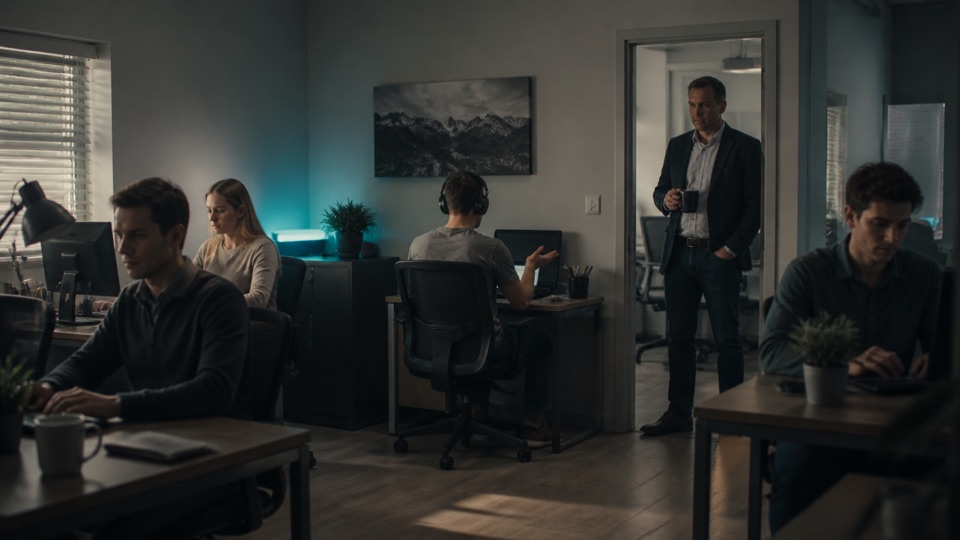
The small-team coaching problem
On a small team, the person who coaches is usually the owner or a manager who also sells. Coaching happens in the gaps, which means it mostly does not happen. 73% of sales managers spend under 30 minutes a week coaching a rep (ATD 2025, Gong 2025), and on a team without a dedicated manager, many owners would be glad to hit that number.
The usual substitute is a training event. Someone runs a workshop or buys a course, the reps nod along, and within weeks the old habits are back. 84% of what reps learn in training is gone within 90 days (Sales Performance International). A small team feels this harder than a large one, because each rep is a bigger share of revenue and there is no bench to absorb a weak quarter.
What AI coaching actually replaces
Strip away the label and AI coaching does three jobs that a small team cannot staff. It gives every rep a practice partner for the moments they keep losing, on demand, without pulling a manager off the floor. It listens to and scores real calls so that someone other than the rep knows what happened. And it ranks the team so the owner knows where to spend the half hour they have.
None of those jobs is new. Large companies pay enablement teams and full-time sales managers to do them. The difference is that a small team was never going to hire those people, so the realistic comparison is not AI against a great sales manager. It is AI against nothing happening at all.
- Daily practice partner: role play the hard moments without a manager
- Call scoring: an objective read on every real conversation
- Prioritization: which rep needs attention this week, and on what
What AI coaching cannot do for you
It cannot set the standard. If you have never written down how your best calls go, the tool has nothing to score against except generic sales skill. The owner still has to define the process: what gets confirmed, what gets presented, how the close is asked for, how the next step is booked. That is an afternoon of work, and it is the most valuable afternoon in the whole setup.
It also cannot make the hard conversation for you. When the data shows a rep skipping the work, someone still has to sit down with them. What the tool does is make that conversation short and factual instead of long and personal. On a small team where everyone knows each other, that difference matters more than it sounds.
What to look for so it does not become shelfware
The failure mode for small teams is a tool that depends on someone remembering to use it. Look for a loop that runs on its own. In Revenue OS, Sales Academy delivers daily lessons with an AI role play at the end, scored in about 60 seconds on script adherence, objection handling, close attempt, energy and tone, and follow-up setup. Real calls are scored against six core skills plus your own process at 60% weight, with the best and worst moment timestamped and the result synced to HubSpot.
Then the correction is automatic. A call under 80 becomes a redo due 6pm the next business day, re-fought against an AI customer seeded with the real customer's words. Nobody has to assign it or chase it. That is the part that makes it work on a team with no spare manager, because the system carries the follow-through that a person would otherwise forget.
How to tell whether it is working
Do not judge it on logins. Judge it on whether behavior on real calls changes. Pick the one or two moments your team loses most often and watch whether the real-call scores on those moments move over the following weeks. If reps are practicing and the live scores climb, it is working. If reps are practicing and nothing changes on live calls, the practice is aimed at the wrong moments.
The other measure is your own time. The Compliance Score gives you one number per rep, 0 to 100, recalculated nightly from training completion at 30%, daily tasks at 25%, role play quality at 25%, and manager enforcement at 20%. If you can open one screen on Monday and know who needs you and why, without listening to a single recording, the tool has given back the hours it was supposed to.
The short version
- On a small team the real comparison is AI coaching against no coaching at all, not against a great sales manager.
- AI coaching replaces three unstaffed jobs: a daily practice partner, call scoring, and prioritizing the owner's time.
- The owner still has to define the process and have the hard conversations; the tool makes both faster.
- Judge it by whether real-call scores move on the moments you lose most, not by how often reps log in.
Questions owners ask
How small is too small for AI sales coaching?⌄
Team size matters less than whether your reps are having enough sales conversations for practice and scoring to make a difference. If even one or two reps carry a meaningful share of revenue, the cost of their bad habits adds up quickly, and a daily practice and scoring loop is usually worth more on a small team than on a large one.
Will my reps actually use it?⌄
They will if it is part of how the job is measured rather than an optional extra. When daily lessons, role play quality and completed redos feed a score the owner reads every week, practice becomes part of the work. When it is optional and nobody looks, usage fades, which is true of every training tool.
Do I need a sales manager to run it?⌄
No, though someone has to own the standard. The owner can define the process once, and the loop handles daily practice, scoring and redos without a manager assigning each one. The owner's job becomes reading the Compliance Score, spending their limited coaching time on the reps at the top of the queue, and having the direct conversations the data points to.
Your best month ever, and the plan to beat it.
Break Your Revenue Record