
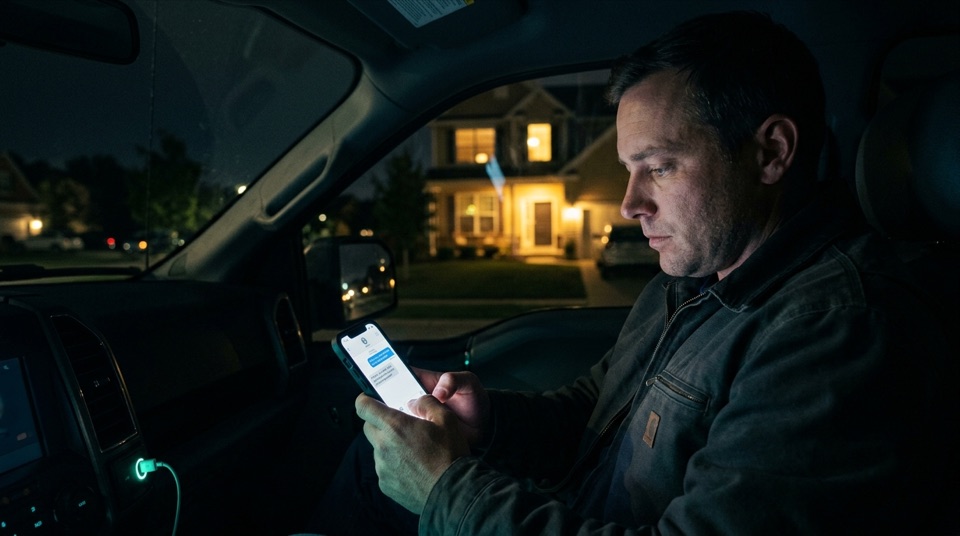
The job was there and then the phone stopped ringing
Your rep ran a clean inspection. The homeowner was engaged, asked good questions, said they would talk to their spouse and call back Thursday. Thursday came and went. The rep texted once on Friday. Nothing. On Monday there were nine new storm appointments and the quiet homeowner dropped to the bottom of the list. Three weeks later a competitor's dump trailer is in the driveway.
Ask the rep what happened and the answer is "they went with someone else." That is true and it is not the reason. The reason is that one text on Friday is not follow-up. It is a gesture. The homeowner was talking to two other companies, one of them called on Saturday with a real reason, and the homeowner signed with the one who was present when the decision got made.
This is the quietest leak in roofing. Lost jobs at the table are visible because the rep comes back without a signature. Lost jobs to silence never register. They sit in the CRM as "following up" until someone closes them out months later. Nobody counts them and they add up to more than the table losses in most companies.
Why roofing reps stop after one or two touches
Reps stop for three reasons. First, they do not want to be annoying, and they have no idea what to say beyond "just checking in." A rep with nothing useful to say feels like a pest, so they stop. Second, storm volume. During a storm there is always a fresh appointment that feels more likely to close than the one that went quiet. Third, nobody can see it. If the owner only sees closed revenue, a rep who never follows up looks the same as one who does until the season is over.
All three are fixable. The first is a words problem. The second is a process problem. The third is a visibility problem. None of them is a character problem, which is good news, because character does not change in a month and words, process, and visibility do.
- No useful reason to reach out beyond checking in
- Fresh storm appointments feel more urgent than stalled ones
- Nobody can see whether the follow-up happened
Build the sequence: every touch has a reason
Write down the follow-up sequence for a roofing job that did not sign at the table. Twelve touches over about three weeks, across text, call, and a drive-by if the address is on the way. Each touch has a reason that is useful to the homeowner. The photos from the roof, organized and sent. A note on what the adjuster will look for. A weather alert before the next front, with an offer to tarp. The answer to a question they asked at the table. News that the crew calendar is filling for the month.
The reason is the whole thing. "Just checking in" asks the homeowner to do work. "Here are the photos of the north slope so you have them for the adjuster" gives them something. Homeowners do not get annoyed by useful. They get annoyed by needy. A sequence of twelve useful touches makes your rep the most present professional in the homeowner's decision, and presence wins when the three quotes are close.
Give the reps the words for each touch, not a bullet point. A rep who has to compose a text from scratch at nine at night will not send it. A rep who has a proven text to copy, adjust one line, and send will. Month two of the Sales Academy in Revenue OS is built around exactly this: the follow-up sequence, the words for each touch, and how to re-engage after the adjuster meeting without sounding desperate.
When the sequence is not enough: named plays for a stuck job
Some jobs stall in ways the standard sequence does not fit. The homeowner signed with the adjuster meeting pending and then the agent told them to wait. The spouse who was not at the table is now against it. The claim came back short and the homeowner thinks the job is dead. Each of those needs a specific play, not touch number seven.
Good reps carry a handful of these plays in their head. Most reps do not. The Deal Helper in Revenue OS takes a plain description of the stalled deal, two or three sentences, and returns three named follow-up plays with the exact words and the reason each one works, and the outcome is logged per rep. The value is not that the rep gets a script. It is that the rep gets a next move at the moment they would otherwise give up, and the owner can see which plays actually reopen jobs in your market.
The logged outcomes are the part owners underrate. After a season you know that the supplement-explanation play reopens short-scope jobs and the spouse-conversation play mostly does not. That is knowledge your company keeps, and it goes into the next version of the sequence.
Make the follow-up visible or it will not happen
The final fix is the one that makes the other two stick. Follow-up has to show up in a number the rep and the owner both see, every day. Two places to put it. First, in the scored appointment: follow-up setup is one of the six skills scored on every recorded conversation, so a rep who leaves the table without booking the next step loses points that night. Second, in the daily tasks that feed the rep's nightly score, which counts at 25% of the total.
That turns follow-up from a virtue into a task with a checkbox and a consequence. The rep who did nine of twelve touches on the quiet homeowner has a higher number than the rep who sent one text, and both of them can see it. You spend two minutes in the morning looking at who is below the line instead of asking six reps whether they called the Hendersons back.
Do this for one season and the silent losses stop being silent. The stalled jobs get worked, the ones that reopen show up as revenue in weeks four through eight, and the number that grows is the one you did not know you were losing. That is where a roofing company finds the revenue to break its record without buying another lead.
The short version
- Jobs lost to silence after the inspection outnumber jobs lost at the table in most roofing companies, and nobody counts them.
- Reps stop following up because they lack useful words, storm volume pulls them forward, and nobody can see it.
- Write a twelve-touch sequence where every touch gives the homeowner something, with exact words for each.
- Put follow-up setup and follow-up tasks into a nightly score so the work is visible before the season is over.
Questions owners ask
How many times should a roofing rep follow up after an inspection?⌄
Plan on twelve touches over about three weeks across text, call, and drive-by. 80% of sales are made between the 5th and 12th follow-up attempt, and 48% of salespeople never follow up at all (from the Million Dollar Follow-Up course). Most reps stop after one or two, which is why the homeowner signs with whoever is present when the decision gets made.
How do roofing reps follow up without annoying the homeowner?⌄
Give the homeowner something on every touch. Roof photos organized for the adjuster, a note on what the adjuster will look for, a weather alert before the next front with an offer to tarp, an answer to a question from the table. Homeowners are annoyed by "just checking in" because it asks them to do work. Useful touches make the rep the most present professional in the decision.
How can an owner see whether reps are actually following up?⌄
Put it in a number. Score follow-up setup on every recorded appointment so a rep who leaves without booking the next step loses points that night, and count follow-up touches as daily tasks in a nightly score per rep. Then the owner reads one ranked list in the morning instead of asking each rep whether the callback happened.
See how the system runs in Roofing & Exteriors.
Revenue OS for Roofing & ExteriorsYour best month ever, and the plan to beat it.
Break Your Revenue Record