
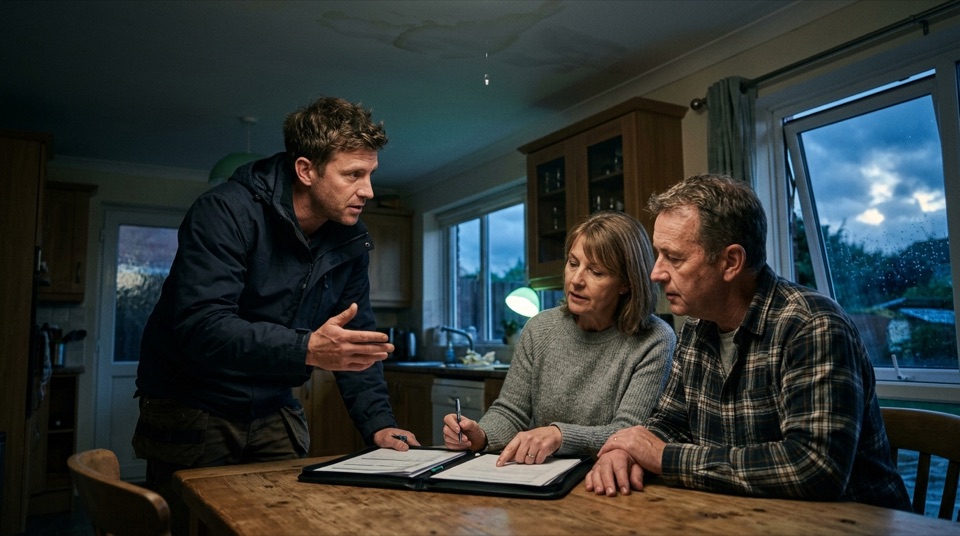
Storm leads are expensive and your reps leave half on the roof
A storm rolls through, the phones light up, and for six weeks you have more inspections than trucks. Then the leak shows up. The rep gets on the roof, finds the damage, sits at the kitchen table, and the homeowner says they want to wait on the adjuster, or get two more bids, or talk to their spouse. The rep says fine and leaves a card. Half those jobs go to whoever calls back first.
Retail jobs leak the same way, just slower. A good inspection, a price that makes the homeowner flinch, and a follow-up that never happens because the rep is already chasing the next door. The lead cost the same either way. The difference between a signed agreement and a lost lead is about twenty minutes at a table, and most owners never hear a second of it.
You already know the leak is in the conversation. What falls apart is the moment the homeowner pushes back and the rep does not have a clean answer for the adjuster excuse, the deductible question, or the neighbor who got it done cheaper. You hear about it after the fact, if you hear about it at all. Most of the time the job just shows up as a lost lead in the CRM with a note that says following up.
Why the training you already paid for did not fix it
Training alone has not fixed this, and you have probably paid for it more than once. A sales trainer comes in, the team is fired up for two weeks, then storm season hits and everyone goes back to what they did before. 84% of what reps learn in training is gone within 90 days (Sales Performance International). Fewer than half of companies reinforce training after paying for it, and only 29% of companies can see whether training changed what their reps do.
Roofing is worse than most trades on this point because the busy season is exactly when nobody has time to coach. The owner is on roofs, the manager is running supplements, and the reps are booked from eight to dark. Whatever was taught in March is gone by the first hailstorm in May, and there is no moment in the storm to teach it again.
So the fix cannot be another event. It has to be something that runs every week without the owner standing in front of the room. Four steps: learn a skill, practice it, use it on a real homeowner, and correct the gap. Then one score that shows who did the work.
Learn: one lesson a day, in the order the objections arrive
The lessons have to be short enough to fit before the morning meeting and specific enough to use that afternoon. Twenty minutes is the right size. Longer than that and reps skip it during a storm. Shorter and nothing lands.
The order matters. Objections first, because that is where roofing reps live: the adjuster stall, the get-more-bids stall, the price flinch. Follow-up second, because the jobs that did not sign at the table are the ones that decide the season. Ticket and pricing third, so reps stop discounting to close once the objections are handled.
In Revenue OS this is the Sales Academy: Jordan Stupar's complete method as a 90-day plan, 7 courses and 140 lessons, one 20-minute lesson per rep per weekday with a workbook and quiz after each, and a certification per course. Month one is objections. Month two is follow-up. Month three is ticket and pricing. Whatever you use, the shape is the same: daily, short, in the order the money leaks.
Practice: run the objection before the real kitchen table
Before a rep sits at a real table, they should have heard "we want to get a couple more bids" fifty times and answered it fifty times out loud. That does not happen in a conference room with another rep playing the homeowner. It happens against a simulated customer that pushes back the way a homeowner does and does not let the rep skip the hard part.
The practice needs a score, or it becomes optional. Five criteria are enough: did the rep run the process, how did they handle the objection, did they ask for the agreement, how did they sound, and did they set up the next step. Each is worth 20 points. A 70 clears. Three scores under 60 in a row should open a manager action, so a rep cannot quietly skip the work during the season when skipping is easiest.
The Customer AI in Revenue OS runs this by text or live voice, across 5 personas plus custom and 3 difficulty levels, scored in about 60 seconds with a coach's note. A new rep starts against a friendly homeowner with one objection. A veteran runs the skeptical spouse who already has two bids and a brother-in-law in the trade.
Implement: the real appointment is the test that counts
Practice only matters if it shows up at the table, and the only way to know is to hear the table. The rep records the appointment from their phone with the homeowner's consent, or the office uploads the recording. Every conversation is transcribed and scored on six skills: value stacking, objection handling, close timing, price presentation, follow-up setup, and talk-to-listen ratio. Then it is scored against your own process, weighted at 60%, because your kitchen-table steps matter more than any generic method.
The best and worst moment are timestamped. You do not listen to forty minutes. You jump to minute 26, where the homeowner said "let me wait for the adjuster" and the rep said sure. In Revenue OS a call under 80 becomes a redo due 6pm the next business day, fought again against an AI homeowner seeded with the real homeowner's words. The Deal Helper hands the rep three named follow-up plays, with exact words, for the job that stalled.
Recording carries obligations. The company initiates every recording and owns consent, including in all-party consent states. Audio is deleted 90 days after upload, and no voiceprints are created. Put the policy in writing and have the rep say it plainly at the start of the appointment.
Refine: one number per rep, every night
The last step is the one most owners skip. A score every rep can see turns the daily work from optional to expected. One number, 0 to 100, recalculated nightly: training completion 30%, daily tasks 25%, role play quality 25%, manager enforcement 20%. Reps see where they rank against the team. You see who is doing the work and who is coasting on storm leads.
Your dashboard becomes a coaching queue sorted by urgency, the objections your team loses most, and which reps are actually following up on the jobs they said they would. Shoens Roofing and Moonshot Roofing run this system. It does not replace your canvassers, your inspection process, or your CRM. It sits on top of the appointments your reps already run and makes sure the training shows up at the kitchen table. Close the leak and the same leads break your revenue record next storm season.
The short version
- Roofing revenue leaks at the kitchen table, in the twenty minutes after the homeowner pushes back, not in the lead or the inspection.
- Training fades by the first hailstorm unless it runs weekly: learn, practice, use it on a real homeowner, correct the gap.
- Record and score real appointments against your own process so you hear the exact moment a job was lost.
- Publish one nightly score per rep so nobody coasts through storm volume.
Questions owners ask
Why do roofing reps lose jobs after a solid inspection?⌄
Because the inspection is not where the decision happens. The homeowner decides at the kitchen table, after pushing back with the adjuster stall, the extra-bids stall, or the price flinch. A rep without practiced words for those three moments leaves a card and loses the job to whoever calls back first, no matter how good the roof photos were.
How can a roofing owner coach during storm season with no time?⌄
Stop listening to everything and let a scoring system hand you the exceptions. Every recorded appointment is scored without a manager present, weak calls turn into a redo the rep runs on their own, and a nightly score shows who did the work. 73% of sales managers spend under 30 minutes a week coaching a rep (ATD 2025, Gong 2025). The system fills that gap.
Does a roofing sales system replace canvassers or the CRM?⌄
No. Canvassing gets the door, the CRM holds the record, and the inspection finds the damage. A training and scoring system sits on top of the appointments reps already run. It changes what the rep says when the homeowner pushes back and makes sure the follow-up actually happens, then reports both to the owner in one number.
See how the system runs in Roofing & Exteriors.
Revenue OS for Roofing & ExteriorsYour best month ever, and the plan to beat it.
Break Your Revenue Record