
It is on the checklist and it still does not happen
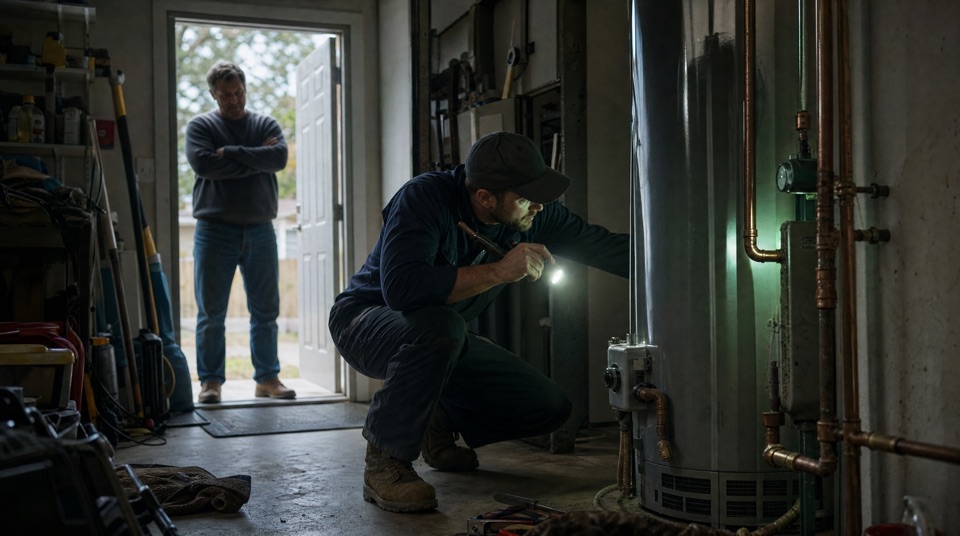
Ask your techs and every one of them will tell you they do the inspection. Pull the paperwork and the boxes are ticked. Listen to the calls and you will hear the truth: a fast fix, a friendly goodbye, and no walk of the house at all. The box got ticked in the driveway.
This is not dishonesty so much as avoidance. The tech knows the inspection is expected. They also know that raising a second problem in a customer's home feels, to them, like upselling. They came to stop a leak. They stopped it. Asking to look at the water heater feels like reaching, and reaching is the thing most techs got into the trades specifically to avoid.
What it costs when the walk does not happen
Every skipped inspection is a job you have already paid to acquire and then declined to find. You paid for the lead, the truck roll, the fuel and the hour. The tech is standing inside the house with the customer's trust already earned by fixing the original problem. That is the cheapest access to a second job you will ever have, and it evaporates the moment the van pulls away.
The customer does not think you missed anything. They think their plumber came and fixed the sink. When the water heater fails in February, they search, they call whoever answers, and the job goes to somebody who never earned the trust you earned. You do not experience this as a loss, because you never saw it. It shows up only as an average ticket that will not move and a replacement business that stays smaller than your service business.
- Water heater age never checked or mentioned
- Shutoff valves and supply lines not looked at
- No note left with the customer about what was seen
- Membership never offered after the diagnosis
Why more training on the checklist will not fix it
The instinct is to retrain the checklist. Bigger laminated card, more items, a meeting about why the inspection matters. It does not work, because the tech does not have a knowledge gap. They can recite the checklist. They have a discomfort gap, and a checklist does not address discomfort.
What actually changes behavior is having words. A tech who skips the inspection usually cannot picture how to ask. They imagine some slick line they would never say. Give them a plain sentence that sounds like them, have them say it out loud twenty times, and the discomfort drops enough for the habit to survive contact with a real kitchen. 73% of sales managers spend under 30 minutes a week coaching a rep (ATD 2025, Gong 2025), which is why this rarely gets rehearsed with anyone.
Give them the sentence, then make them say it
The ask is not a pitch. It is permission: while I am here, do you mind if I take two minutes and check the rest of the water in the house, so you know where you stand. That is it. It is honest, it takes the pressure off, and it is the kind of thing a plumber can say without feeling like a salesman.
Customer AI & Role Play gives the tech an AI homeowner to say it to, by text or live voice, across 5 personas plus custom and 3 difficulty levels, scored in about 60 seconds on script adherence, objection handling, close attempt, energy and tone, and follow-up setup, 20 points each with a coach's note. Month one of the Sales Academy is objections, delivered as one 20-minute lesson per weekday with a workbook and quiz after each, so the rehearsal has something to rehearse.
Then see who actually walked the house
This is where the checklist finally gets honest. Intel Suite records, transcribes and scores real service calls, and your own process carries 60% of the weight. If your standard is that the tech asks permission, walks the house, notes the water heater age, and offers the membership after the diagnosis, then a call where none of that happened scores low, and it scores low with a timestamp on the moment it should have happened.
You stop asking techs whether they did the inspection and start reading whether they did. A call under 80 becomes a redo due 6pm the next business day against an AI customer seeded with the real homeowner's words. Over a month you can see plainly which techs walk the house every time, which ones do it when the job is easy, and which ones never have.
One number, and the work you were already standing next to
The Compliance Score is one number per tech, 0 to 100, recalculated nightly: training completion 30%, daily tasks 25%, role play quality 25%, manager enforcement 20%. The dashboard ranks the team and sorts a coaching queue by urgency, so the conversation is with the two techs who need it rather than the whole shop at a Monday meeting.
None of this asks a plumber to become a salesperson. It asks them to tell the customer what they saw. The work was already in the house. You already paid to be standing next to it. This is about making sure somebody looks.
The short version
- The inspection gets skipped out of discomfort, not laziness. Techs read it as upselling rather than reporting.
- It is the cheapest second job available to you, because the lead, the truck roll and the trust are already paid for.
- A bigger checklist will not fix a discomfort problem. Techs need a plain sentence they would actually say.
- Rehearse the permission ask out loud until it survives a real kitchen, then score whether it happened.
- Weight your own process at 60% of the call score so the inspection is measured, not self-reported.
Questions owners ask
How do I know if my techs are really doing the whole-home inspection?⌄
Self-reported checklists will not tell you, because the box gets ticked either way. Score the call itself against your process and the answer is in the transcript: did the tech ask permission, did they walk the house, did they name what they found. Run it by technician over 30 days and the pattern is obvious.
Does the inspection annoy customers?⌄
Asked as a pitch, yes. Asked as permission to report on what they own, very rarely. The difference is the framing and the fact that the tech is not asking for a decision. Most homeowners have no idea how old their water heater is and would rather hear it from the plumber already standing there than from a stranger in an emergency.
Should the inspection happen before or after the original repair?⌄
After. The trust that makes the walk welcome is earned by fixing the thing they called about. Solve the stated problem first, confirm the customer is happy with it, then ask permission for the two-minute walk. Offering the membership after the diagnosis rather than before follows the same logic.
See how the system runs in Plumbing.
Revenue OS for PlumbingYour best month ever, and the plan to beat it.
Break Your Revenue Record