
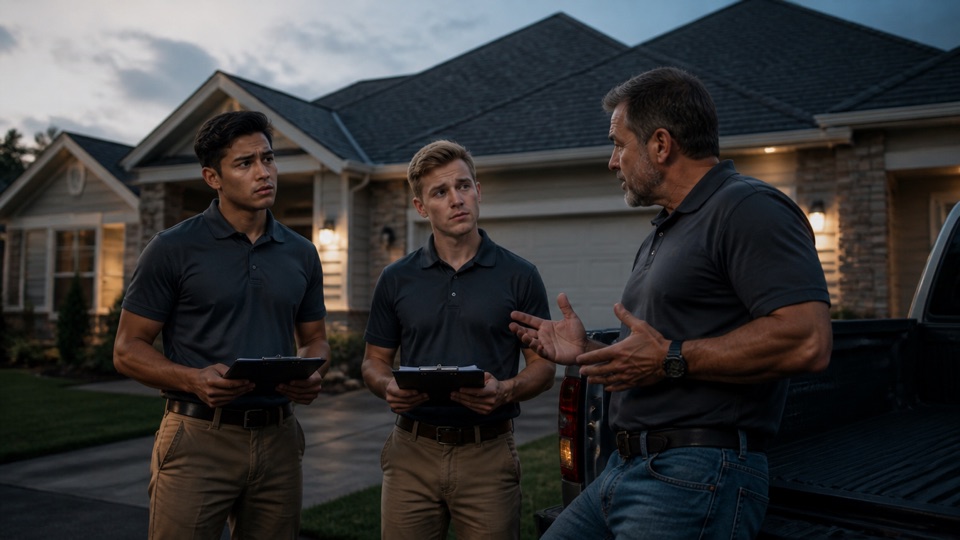
The ride-along that never transfers
Every roofing owner has tried it. Your top rep closes twice what anyone else does, so you put the new hires in the truck with them for two weeks. The new reps come back impressed. Then they run their own appointments and close at the same rate they would have without the ride-along.
Meanwhile your best closer lost two weeks of their own appointments, or ran them with a passenger who changed the feel of the table. You paid for the training twice, once in the closer's lost deals and again in the new reps who still do not know what to do.
It is not that the closer did a bad job. Watching someone be good at something is not the same as learning how to do it. The new rep saw the outcome. They never saw the decisions.
Why great closers make poor trainers
Ask your best rep how they handle "we want to wait for the adjuster" and you will get a shrug and a story. They do not run a script in their head. They read the room, adjust, and land it, and they stopped thinking about the steps years ago. That is exactly what makes them good, and exactly what makes them hard to copy.
Closers also tend to teach their personality instead of their process. "Be confident." "Make them like you." A twenty-four-year-old new rep cannot install confidence on command. They can learn what to say when the homeowner asks for two more bids, if somebody tells them the words.
And your best closer has a full calendar. Every hour spent training is an hour not selling, so the training gets squeezed into the truck between appointments and the parking lot after. It was never going to be consistent, because it was never anyone's actual job.
Pulling the process out of their head
Start by recording your best closer's real appointments, with the homeowner's consent, and listen for what repeats. How they open after the inspection. How they walk through the photos. The exact words they use when the price lands and when the homeowner hesitates. You will find that their instinct is more consistent than they think.
Write that down as your kitchen-table process, step by step, in plain language. Then pull out the objections they handle best and write their answers word for word. That document is worth more than any ride-along, because every rep can read it, practice it, and be measured against it.
Then let your closer review it. Not teach it, review it. They will catch what is missing in ten minutes, and you get their knowledge without taking them off the roof for two weeks.
- Record the best closer's real appointments and listen for what repeats
- Write the kitchen-table process and the objection answers word for word
- Have the closer review the document instead of teaching it
Turning one rep's process into the whole team's habit
A written process does nothing until reps practice it. In Revenue OS the process becomes the AI role play every rep runs each weekday against a simulated homeowner, scored in about 60 seconds on five criteria at 20 points each: script adherence, objection handling, close attempt, energy and tone, follow-up setup. A 70 clears. Three scores under 60 in a row open a manager enforcement action. The new rep hears the adjuster stall dozens of times before they hear it at a real table.
The Sales Academy covers the foundations your closer never thought to mention, so reps learn why the process works and not just the words. Then real appointments are recorded from the rep's phone, transcribed, and scored on six skills: value stacking, objection handling, close timing, price presentation, follow-up setup, and talk-to-listen ratio, plus your own kitchen-table process at 60% weight. That last piece is the point: every rep is now measured against the way your best closer actually sells.
Any appointment under 80 becomes a redo due 6pm the next business day. The coaching your closer could never fit into their week happens anyway, on the exact moment each rep went off the process.
What the owner gets back
Your best closer gets their calendar back, and you stop paying for training with their deals. The rest of the team gets a process they can actually learn, practice they actually do, and a score that tells them how close they are to selling like the person at the top of the board.
You get one number per rep, the Compliance Score, from 0 to 100 and recalculated nightly: training completion 30%, daily tasks 25%, role play quality 25%, manager enforcement 20%. 73% of sales managers spend under 30 minutes a week coaching a rep (ATD 2025, Gong 2025). A system built from your best rep's process is how that small window of coaching starts to matter.
Recording is initiated by your company, which owns consent including in all-party consent states. Audio is deleted 90 days after upload and no voiceprints are made. Shoens Roofing and Moonshot Roofing run their teams on this system. Stop asking your best closer to clone themselves. Write down what they do, make everyone practice it, and score it every day. That is how a roofing company stops depending on one great rep and starts building a team that can hit a revenue record together.
The short version
- Great roofing closers run on instinct, so ride-alongs show new reps the outcome but never the decisions.
- Record your best closer's real appointments and write their kitchen-table process and objection answers down word for word.
- Have the closer review the process instead of teaching it, so their calendar stays on selling.
- Turn the process into daily role play and score every rep's real appointments against it.
Questions owners ask
Should my top roofing rep be the one who trains new hires?⌄
Usually not as the main trainer. Top closers run on instinct and struggle to explain the steps, and every hour they train is an hour they are not selling. Use them as the source of the process instead: record their appointments, write down what they do, and let them review it.
Why don't ride-alongs work for roofing sales training?⌄
Because watching someone close is not the same as learning how. The new rep sees the result but not the decisions behind it, and has no way to practice the moments that matter before the next real appointment. A written process plus daily practice and scored appointments transfers far more than two weeks in the truck.
How do I turn my best closer's approach into a process the team can follow?⌄
Record their real appointments with consent, listen for what repeats, and write it down as your kitchen-table process with word-for-word objection answers. Then make it the daily role play every rep runs and score real appointments against it, so the whole team is measured on the way your best rep actually sells.
See how the system runs in Roofing & Exteriors.
Revenue OS for Roofing & ExteriorsYour best month ever, and the plan to beat it.
Break Your Revenue Record